What Are Hempel Paints Used For on Ships?
Hempel Paints are a range of marine coatings designed to shield a vessel's hull, tanks, and steel structure from rust, marine growth, and everyday wear during years spent at sea. The company traces its roots back to Denmark in 1915, when it started life as Hempel's Marine Paints Ltd., and it has spent more than a hundred years refining coating systems for both new vessel construction and routine dry-dock maintenance. In the UAE, Aurora Shipping LLC serves as an authorized Hempel distributor, providing ship owners in Dubai, Jebel Ali, and Abu Dhabi with direct access to genuine products and hands-on technical support.
Which Parts of a Ship Are Coated With Hempel Paint?
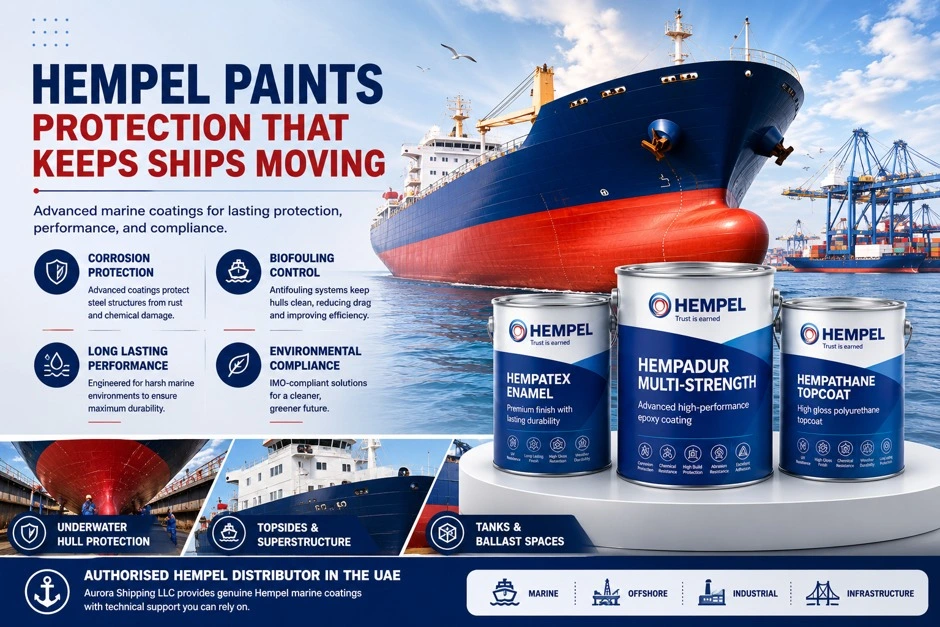
A vessel gets Hempel coatings in three main areas: the submerged hull, the topsides and superstructure, and the internal tanks and ballast spaces. Since each of these zones deals with its own set of stresses, Hempel has developed a dedicated product line built specifically for it.
- Underwater hull: Antifouling ranges such as Hempel's Olympic line stop barnacles, algae, and other marine organisms from taking hold on the hull.
- Topsides and superstructure: Finish coats such as Hempatex Enamel shield exposed steel from sun exposure, salt spray, and everyday abrasion.
- Tanks, ballast spaces, and structural steel: Thick-film epoxy primers such as Hempadur protect against internal rust in tight, often damp compartments.
Getting the right product onto the right surface is a central piece of ship-supply and dry-dock planning, so owners don't have to guess which coating belongs where.
Why Do Vessels Need Marine Coatings in the First Place?
Ships require specialized coatings because bare steel corrodes quickly in salt water, and an uncoated hull accumulates marine growth that increases drag and raises fuel consumption. Ignore either issue and a vessel's working life shortens while upkeep costs climb.
There's a direct connection between biofouling and fuel burn: a fouled hull creates more hydrodynamic resistance, forcing the engine to work harder just to hold speed. That's why coating performance gets treated as a running cost, not simply a matter of appearance, and it's also why the industry has been shifting toward foul-release coatings aimed squarely at cutting fuel use and emissions.
Regulation adds further pressure. Analysts now describe the marine coatings market as entering a "dual compliance phase," in which owners have to hit emissions targets and satisfy tougher environmental rules at the same time, turning coating selection into a compliance decision as much as a maintenance one.
How Does Hempel Paint Differ From Ordinary Paint?
Hempel Paint is built for permanent submersion, harsh UV exposure, and resistance to biological growth, none of which standard household or architectural paint is designed to handle. Wall paint just needs to dry and cure once; marine coatings have to keep performing for years under constant chemical and physical stress.
The Olympic antifouling range is a good example. It relies on self-polishing, ion-exchange-based technology that forms a hydrolysable active layer, continuously refreshing the antifouling surface as the vessel moves through the water. A number of these formulations are also tin-free and meet the standards of the IMO's International Convention on the Control of Harmful Anti-Fouling Systems on Ships, adopted in October 2001, a requirement ordinary paint was never built to satisfy.
Hempel has also been pushing into newer chemistry. Its Hempaguard fouling-release technology itself isn't new, but in mid-2025 Hempel introduced Hempaguard NB, a silicone-based hull coating built specifically for newbuild vessels, optimized for application during construction without requiring an extra dry-dock, and aimed at owners who want reduced drag without depending on biocide release
Hempel Product Lines Compared: Which Coating Does What?
Picking between Hempel's product families becomes much simpler once you know what each one is meant to do. The table below breaks down three of the core lines used across fleets in the UAE.
| Product Line | Primary Use | Key Characteristic | Best Suited For |
|---|---|---|---|
| Hempadur Multi-Strength | Primer / anti-corrosive base coat | Advanced high-performance epoxy coating with high-build protection for steel and tanks | Ballast tanks, structural steel, newbuild priming |
| Hempatex Enamel | Topcoat / finish coat | Premium enamel finish with lasting durability against UV and abrasion | Topsides, superstructure, and deck areas |
| Hempathane Topcoat | Finish coat | High-gloss polyurethane topcoat for a premium, long-lasting appearance | Superstructure, deckhouses, and areas needing high-gloss aesthetic finish |
Where Can Ship Owners in the UAE Source Hempel Paints?
Owners and operators based in the UAE can source Hempel Paints through an authorized distributor located in Dubai Maritime City. Buying through an authorized channel matters because it ensures the product is genuine, batches are handled correctly, and buyers get access to Hempel's technical data sheets for each formulation.
That includes:
- Certified marine coatings, antifouling products, and their supporting technical documentation
- On-site technical guidance for matching coatings to vessel type and trading pattern
- Coordination with dry-dock schedules as part of broader shipping agency and marine services support across Jebel Ali, Port Rashid, and Abu Dhabi
This kind of local access is especially useful for owners who also need IHM and Green Passport documentation, since the coatings used on a vessel are one of the data points tracked under hazardous material inventories.
Frequently Asked Questions
Is Hempel Paint only used on large commercial ships?
No. Hempel makes coating systems for commercial vessels, yachts, offshore structures, and industrial assets, with formulations tailored to each use case.
How often does a ship need to be repainted with Hempel Paints?
It varies by coating system and trading pattern, but antifouling is typically renewed at each dry-docking, generally every 24 to 60 months depending on the product chosen.
Does Hempel Paint help with fuel efficiency?
Yes. A hull kept clear of fouling stays smoother, which means less drag and less fuel burned to hold speed — one of the main reasons demand for foul-release and self-polishing antifouling systems keeps growing.
Who is an authorized Hempel distributor in the UAE?
Aurora Shipping LLC is an authorized distributor of Hempel Paints in the UAE, supplying certified coatings along with full technical support.
What's the difference between antifouling and anti-corrosive coatings?
Antifouling coatings stop marine organisms from attaching to the hull, while anti-corrosive coatings like Hempadur protect the underlying steel from rust and chemical breakdown, typically sitting beneath the antifouling layer.
Can Hempel coatings support IMO compliance?
Yes. Several Hempel antifouling products are formulated to meet the IMO's Anti-Fouling Systems Convention, and coating selection is also tracked as part of IHM documentation.
Protect Your Vessel with the Right Hempel Coating Partner
Choosing the right Hempel Paint is about more than picking a product off a shelf; it's about protecting the asset your operation depends on. From hull antifouling to internal tank coatings, every layer plays a part in how long a vessel stays seaworthy, efficient, and compliant.
Choosing the right supplier is what makes that possible. As an authorized Hempel distributor based in Dubai Maritime City, Aurora Shipping LLC helps you select the right system for your vessel, fits it around your dry-dock schedule, and backs it with the same team already managing your port calls, cargo, and compliance paperwork.
If you're planning a dry-dock, a newbuild, or just want expert advice on your next coating cycle, reach out to Aurora Shipping LLC — our team is available 24/7 to help you protect what keeps you moving.