IHM & Green Passport Compliance: What Every Ship Owner Should Know
IHM stands for Inventory of Hazardous Materials, a certified record of every hazardous substance present in a vessel's structure, equipment, and systems, while Green Passport is the earlier term for the same concept, first introduced by class societies before the IMO standardized it under the term IHM. Ship owners operating vessels of 500 gross tonnage and above need a valid, certified IHM to enter EU and EFTA ports. Understanding the difference between the two terms, and what compliance actually requires, matters for any owner managing a vessel operating in or near European waters.
What Is IHM (Inventory of Hazardous Materials)?
An IHM is a certified inventory listing every known hazardous material on board a vessel, including substances like asbestos, PCBs, and certain heavy metals found in a ship's construction, equipment, and systems. The inventory identifies these materials so crew members stay safe during the vessel's operational life and so maintenance and repair work can proceed with full knowledge of what's on board. A certified surveyor typically boards the vessel, collects material samples, and sends them to accredited laboratories for analysis. Based on those results, the inventory is compiled and certified by an approved classification society, such as DNV GL, ABS, or Lloyd's Register.What Is a Green Passport, and How Does It Relate to IHM?
Green Passport was the original term used for this hazardous materials record, introduced by classification societies before the concept and the terminology were formalized under IMO guidelines as IHM. In practice, the two terms describe the same underlying document, and most of the industry has shifted to using IHM as the standard reference. Ship owners searching for either term are typically looking for the same service: certified identification, documentation, and ongoing maintenance of a vessel's hazardous materials record.Which Ships Actually Need IHM Certification?
Any vessel above 500 gross tonnage flying an EU flag, or calling at EU and EFTA ports, needs a certified IHM under the EU Ship Recycling Regulation, in force since 31 December 2013. That IHM must be continuously updated throughout the vessel's operational life, not just prepared once and filed away. Owners should also know the regulation didn't apply to every vessel at once; it rolled out in stages. Newbuild vessels fell under the requirement first, starting 31 December 2018. Existing vessels then had until 31 December 2020 to catch up and get their own IHM in place. Miss that window entirely, and a vessel can simply be turned away, denied entry or anchorage at EU and EFTA ports until the documentation is sorted.What Happens If a Vessel Doesn't Have a Valid IHM?
A vessel without a certified, up-to-date IHM faces real operational consequences, not just a paperwork gap. Ships lacking valid documentation can be denied entry or anchorage at EU and EFTA ports, which can disrupt schedules and add unplanned costs. Beyond port access, an outdated or incomplete IHM complicates maintenance and repair work, since accurate hazardous materials data is what allows those activities to proceed safely and in line with regulatory standards.Why Does IHM Documentation Need Continuous Updates?
A vessel's hazardous materials record isn't static, since equipment gets replaced, repairs happen, and new components are installed throughout a ship's operational life. Each of those changes can introduce or remove hazardous materials from the inventory, meaning the original IHM can go out of date without anyone noticing until an inspection flags it. Keeping the IHM current means every material change is logged and reflected in the certified documentation, so the record stays accurate whenever it's checked, whether that's during a routine port call or a compliance audit.EU SRR Compliance at a Glance
EU SRR compliance comes down to a few key facts: who it applies to, when it took effect, and what happens if a vessel falls behind. Here's the full requirement broken down at a glance.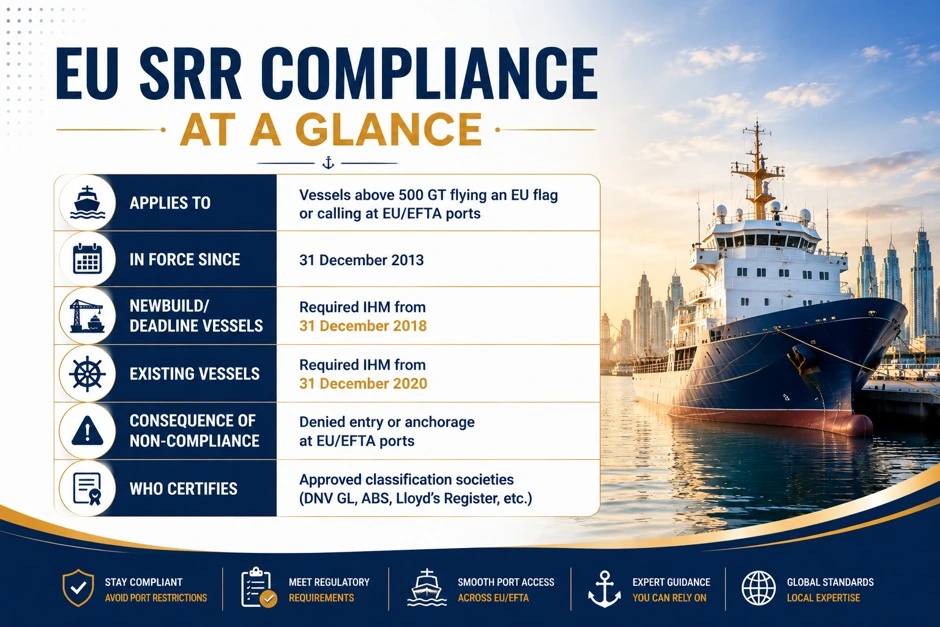
Staying on top of these dates is what keeps a vessel moving instead of stuck waiting on paperwork at port.
Frequently Asked Questions
What's the difference between IHM and Green Passport?
They refer to the same underlying document. Green Passport was the earlier industry term, while IHM is the standardized terminology now used under IMO and EU regulations.
Which vessels are required to have a certified IHM?
Any vessel above 500 gross tonnage flying an EU flag, or calling at EU or EFTA ports, under the EU Ship Recycling Regulation.
Who certifies an IHM once it's completed?
Approved classification societies, such as DNV GL, ABS, or Lloyd's Register, certify the inventory after survey and laboratory analysis are complete.
What happens if a ship arrives at port without a valid IHM?
The vessel risks being denied entry or anchorage, along with complications for any maintenance or repair activity that depends on accurate hazardous materials data.
Why does an IHM need to be updated regularly, rather than done once?
Equipment changes, repairs, and new installations can alter a vessel's hazardous materials profile, so the inventory needs to be updated to remain accurate throughout the ship's operational life.