In-House Logistics vs Cargo Service Providers in UAE
There's a moment every growing business hits, usually right after a shipment goes sideways at customs, or a container sits at Jebel Ali longer than it should have. That's when the question comes up: should we be handling this ourselves, or is it time to bring in someone who does this for a living?
It's not a small decision. Getting it wrong either way costs money, time, or both. Some businesses stick with in-house logistics for years without issue, right up until volume grows or a shipment becomes more complicated than usual. Others bring in a provider too early, before it actually makes financial sense, and end up paying for infrastructure they didn't really need yet. The right call depends less on company size and more on how complex, frequent, and unpredictable the shipments actually are.
What "In-House Logistics" Actually Means in Practice
Running logistics in-house sounds straightforward on paper. Hire a coordinator, build some relationships with customs brokers, handle your own tracking. In reality, it means someone on your team is now responsible for staying current on port procedures, customs documentation, warehousing options, and carrier relationships, on top of whatever their actual job was supposed to be.
For companies moving a handful of shipments a year, that can work fine. The problem shows up as volume grows, or when cargo gets more complex, particularly with project cargo, oversized loads, or anything that needs coordination across multiple UAE ports rather than a single predictable route.
The Real Value a Cargo Service Provider Delivers
A dedicated provider isn't just outsourcing the same work; it's usually a different level of infrastructure entirely. Comprehensive port agency services include coordinating port calls, managing customs clearance, and supporting crew requirements across UAE ports, eliminating the need for businesses to maintain dedicated in-house teams and local port connections.
The quality of cargo services is often reflected in several important operational areas:
- Stevedoring: vetted, experienced handling crews rather than whoever's available that day.
- Warehousing: secure storage that's actually built for cargo, not a spare corner of a facility.
- Tracking: transparent visibility into where a shipment actually is, instead of a string of phone calls to figure it out.
- Cargo clearance: documentation and customs formalities handled as a dedicated service, not an afterthought tacked onto general freight support.
Providers built around this kind of setup, backed by real port experience rather than a generic logistics playbook, tend to exist specifically because doing all of this well, in-house, at scale, is genuinely hard. Aurora Shipping, for example, brings more than 15 years of maritime experience across the Gulf to exactly this kind of coordination, supporting both containerized and project shipments across Dubai, Jebel Ali, and Abu Dhabi.
The Market Is Already Answering This Question
This isn't just a theoretical debate. Across the UAE logistics market, buyers are increasingly combining warehousing, customs brokerage, and freight forwarding under single contracts rather than sourcing each separately. That shift didn't happen because bundling sounds nice; it happened because fragmented vendor relationships were costing shippers time and money, and consolidating under one provider turned out to be faster and more predictable.
Free zones like JAFZA are reinforcing this too, offering bonded, duty-deferred storage with value-added processing built in, the kind of infrastructure that's difficult to justify building in-house unless cargo volume is genuinely massive.
When In-House Actually Makes Sense
To be fair, in-house logistics isn't automatically the wrong call. It tends to work well when:
- Shipment volume is low and predictable, on the same route, month after month.
- The business has already established reliable partnerships with preferred shipping lines or port authorities.
- Cargo is simple, standard containerized goods, with no oversized or project cargo involved.
- There's genuinely enough internal bandwidth to treat logistics as a real function, not a side task.
As shipping activities become more complex, involving multiple UAE ports or specialised cargo, partnering with an experienced cargo service provider becomes increasingly important for maintaining efficient operations.
In-House vs Cargo Service Provider: A Quick Comparison
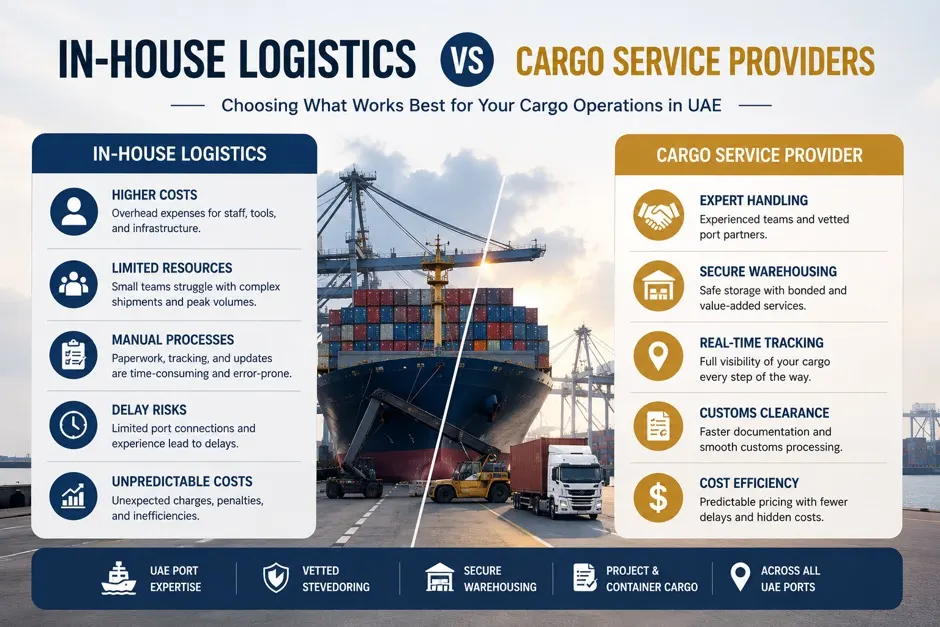
Frequently Asked Questions
Is in-house logistics cheaper than hiring a cargo service provider?
Not always. It can look cheaper on paper, but delays, customs errors, and inconsistent tracking often add hidden costs that outweigh the savings over time.
When should a business switch from in-house to a dedicated provider?
Usually once shipment volume grows, cargo becomes more complex with project or oversized loads, or operations expand across more than one UAE port.
Does a cargo service provider replace an internal logistics team entirely?
Not necessarily. Many businesses keep a small internal point of contact while outsourcing the operational heavy lifting, including port coordination, stevedoring, warehousing, and tracking.
What's the biggest risk of managing logistics in-house at scale?
Inconsistent execution. Without dedicated port relationships and infrastructure, delays and miscommunication tend to increase as volume grows.
Can cargo service providers manage both containerized shipments and project cargo?
A full service provider typically does, covering standard containerized shipments as well as more complex project cargo requiring specialized handling.
Choosing What Works for Your Cargo Volume
There's no universal right answer here; it genuinely depends on volume, complexity, and how many ports a business is actually moving cargo through. But the pattern across the UAE market is fairly clear: as shipments scale up, bundled, provider-led logistics tends to outperform in-house setups on speed, predictability, and cost control.
With over 15 years of maritime experience across the Gulf, Aurora Shipping provides reliable support for containerized and project cargo throughout UAE ports. Our services include trusted stevedoring, secure warehousing, and transparent shipment tracking, helping businesses manage complex logistics with confidence and efficiency.