Shipping Agency in UAE: Why Consolidating Services Saves Time and Risk
Most shipowners don't set out to work with five different vendors for one port call. It just happens gradually, one contact for cargo, another for crew, a third for supply, and before long nobody has the full picture. A shipping agency in UAE exists to fix exactly that problem, pulling port coordination, documentation, crew services, cargo handling, and ship supply under one accountable team instead of scattering them across separate providers.
In ports as busy as Dubai, Jebel Ali, and Abu Dhabi, every extra vendor in that chain is another place where something can slip through the cracks.
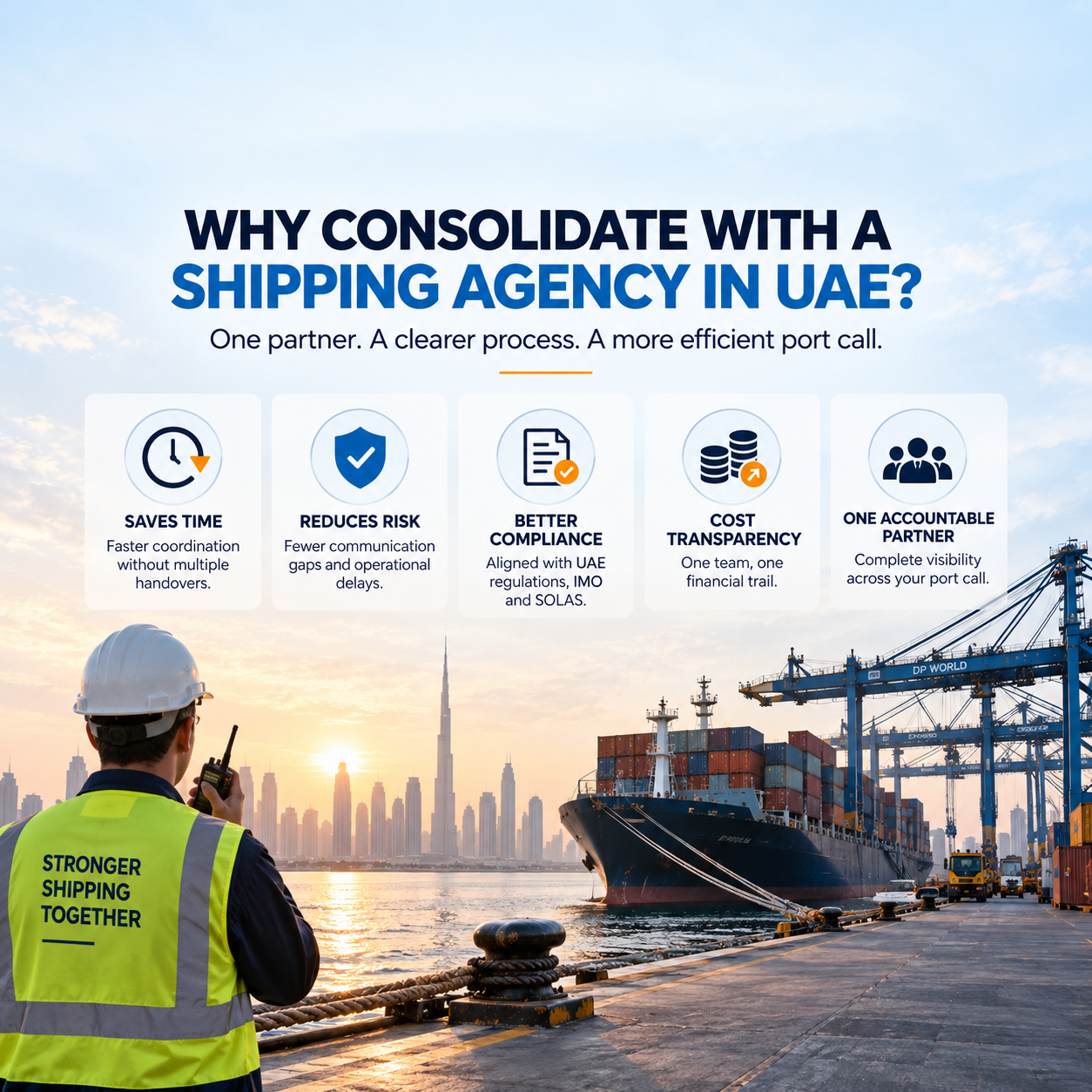
What's actually on a shipping agency's plate?
More than most people assume. A shipping agency isn't just the group that files paperwork; it's managing the entire operational side of a port call, start to finish: coordination, documentation, crew, cargo, and supply, all at once.
Take cargo loading and discharging as one example. Someone has to make sure the quantities match what was agreed, the condition of the goods holds up, and the timeline stays on track. That means working directly alongside stevedores, terminal operators, and cargo surveyors, the core of any cargo service in the UAE, to ensure nothing leaves the vessel without proper sign-off.
When a single provider owns all of that, there's one team you call when something needs an answer.
So why do some owners still split it across vendors?
Old habits, mostly. The industry's traditionally worked this way: separate contacts for separate jobs, and for a simple, low-complexity call, that setup can limp along fine. The trouble starts once things get even slightly complicated.
Crew welfare is where this really shows its cracks. Visa arrangements, medical needs, repatriation — none of it is optional, and in the UAE specifically, immigration rules around crew are strict enough that a knowledgeable local agent isn't a nice-to-have; it's what keeps a small paperwork issue from becoming a real problem.
Spread that same job across three different vendors, and suddenly nobody has a clear picture of where a crew member's paperwork actually stands. That gap, more often than not, is exactly where things go wrong.
What's the actual cost of fragmenting port services?
Miscommunication, mostly, and it's more expensive than it sounds. When no single provider sees the whole port call, small gaps open up. A shipment gets delayed not because anyone did their individual job badly, but because the handoff between the cargo team and the documentation team never quite happened.
There's a financial angle too, and it's not a small one. Freight rates have been volatile, operating costs keep climbing, and across the industry that's putting real pressure on shipowners, operators, and charterers alike. Financial distress spreads quickly in that kind of environment, which makes cost transparency, and having someone actually watch the full picture, more important than it used to be.
Fragmented vendors also make billing errors harder to catch early, since nobody's reviewing the complete financial trail of a port call from beginning to end. Everyone's just looking at their own invoice.
Does consolidating actually save time, or is that just a sales line?
It genuinely does, and the reason is fairly simple: one team already has the context. They don't need updates relayed from three other companies before they can make a call. When port coordination, crew, cargo, and supply all sit with one provider, information moves faster because it isn't bouncing between outside teams first.
That speed matters most exactly when things go sideways:
- A crew visa stuck in processing.
- A cargo count that doesn't add up.
- A berth conflict nobody saw coming.
A consolidated agency can react immediately, because the same people already understand the full situation, not a summary version of it.
Compliance holds up better under this model too. Is the provider, whether a protecting agency or a full port agent, actually licensed by UAE maritime authorities? Do they genuinely understand IMO regulations, SOLAS, and local port bylaws, or are they guessing? One well-versed team answers that consistently across everything they touch, instead of hoping five separate vendors each independently got it right.
Has anything changed legally that affects this?
Yes, and recently. Per Chambers and Partners' Shipping 2026 guide, the UAE overhauled its Commercial Maritime Law, moving well past the old 1981 framework to something that actually reflects how the shipping industry operates today.
Practically, that touches:
- Vessel registration.
- How disputes get handled.
- The process around maritime claims.
An agency that's keeping up with these changes puts a shipowner in a stronger position, particularly when compliance is built into a consolidated service rather than bolted on as an afterthought by whichever vendor happens to be paying attention that week.
One agency vs. several vendors: a quick look
| Factor | Single Shipping Agency | Multiple Separate Vendors |
|---|---|---|
| Communication | One team, centralized visibility | Coordinated across separate points of contact |
| Response speed | Fast, since context is shared internally | Depends on how well vendors coordinate with each other |
| Regulatory compliance | Standardized across all services by one provider | Each vendor manages compliance independently |
| Disbursement transparency | Single consolidated invoice | Multiple itemized invoices from each vendor |
| Crew welfare coordination | Managed by one team across all touchpoints | Managed separately by each specialized vendor |
| Cost structure | May include hub or coordination fees | Allows comparing and negotiating rates across vendors |
Why go with one shipping agency instead of juggling several vendors?
Because one team keeps full visibility across port coordination, crew, cargo, and documentation, and that alone tends to save time and cut down on avoidable risk.
What does a shipping agency actually cover during a port call?
Port coordination, documentation, crew services, cargo handling, and ship supply, all managed together so the turnaround stays on schedule.
How exactly does splitting services across vendors increase risk?
Nobody has the full picture. A handoff gets missed between two providers who each did their own job fine, and the shipment stalls anyway.
Is crew welfare genuinely part of what a shipping agency does?
Yes, and it's a bigger part than people expect: visas, medical needs, repatriation, especially given how strict UAE crew immigration rules are.
What's worth checking before picking a shipping agency?
Whether they're properly licensed, whether their disbursement accounts are actually transparent, and whether they're reachable 24/7, since problems at sea don't wait for office hours.
One team, fewer gaps
At its core, the case for consolidating shipping agency services is about accountability. When one provider handles coordination, crew, cargo, and documentation together, there's nowhere for information to disappear, and no confusion about who picks up the phone when something needs to move fast. That matters more, not less, as UAE ports get busier and the regulatory landscape keeps shifting under everyone's feet.
Based at Dubai Maritime City, Aurora Shipping LLC handles full shipping agency work: port coordination, documentation, crew services, cargo handling, and ship supply. That gives shipowners one accountable team across Dubai, Jebel Ali, and Abu Dhabi instead of a patchwork of vendors who've never spoken to each other.