UAE's New Maritime Law and Your Shipping Agency
For more than four decades, the UAE's maritime sector operated under a single piece of legislation — Federal Law No. 26 of 1981. It served its purpose for a long time. But shipping in 2024 looks nothing like shipping in 1981, and the old law was starting to show its age in ways that genuinely affected how vessels were registered, how disputes were resolved, and who could actually operate under the UAE flag.
That changed with Federal Decree-Law No. 43 of 2023, which came into effect on 29 March 2024. It is the most significant overhaul of UAE maritime regulation in over forty years — and if you own, charter, or operate a vessel in UAE waters, it touches almost every part of how your shipping agency does business on your behalf.
This guide breaks down what actually changed, why it matters, and what it means in practice for shipowners working with a shipping agency in the UAE today.
Why This Law Took So Long to Update
The 1981 law was written for a maritime industry that barely resembles the one operating in the Gulf today. Vessel ownership structures have become more international. Charter arrangements have become more complex. And the UAE's ambitions as a global shipping hub required a legal framework capable of competing with established maritime jurisdictions worldwide.
The old law restricted UAE flag registration almost entirely to vessels owned by UAE nationals or companies where UAE nationals held a majority shareholding. That worked when the UAE's maritime sector was smaller and less internationally integrated. It became a genuine obstacle as the country positioned itself as a serious player in global shipping, logistics, and offshore energy.
The new Maritime Law addresses this directly — and the changes go well beyond a simple legal refresh.
What Actually Changed — The Parts That Matter
Who Can Register a Vessel Under the UAE Flag
This is the headline change, and it is a big one.
Under the old law, registering a vessel under the UAE flag required a majority of UAE national ownership. Under the new law, that requirement has been significantly widened. A vessel can now be registered if the majority of its shares are owned by individuals or companies holding UAE nationality, GCC nationality, or by entities with a domicile, head office, or ship management office based in the UAE.
In practical terms, this means UAE residents of any nationality can now own and register vessels in the UAE, and so can companies incorporated here or vessels managed by UAE-based entities. That is a substantial shift from a law that, for over forty years, kept ownership tightly restricted.
For shipowners considering UAE registration — or for international operators thinking about establishing a UAE-based presence — this single change opens a door that was largely closed before.
A New Ship Register and a New Authority
Vessel registration now sits with a dedicated "Ship Register" under the Ministry of Energy and Infrastructure, replacing the old Maritime Inspection Department that previously handled registration under the Ministry of Transportation.
This is more than an administrative reshuffle. A dedicated register, supported by digital platforms for registration, is designed to streamline a process that was historically slow, paperwork-heavy, and spread across multiple regulatory touchpoints. For shipowners, this should translate into faster registration timelines and fewer bureaucratic delays — though the practical experience will depend on how smoothly the new system rolls out.
Under-Construction and Chartered Vessels Can Now Be Registered
Previously, registering a vessel still under construction was barely addressed in UAE law. The new Maritime Law introduces a dedicated "Under-Construction Ships Register," with the shipbuilder — rather than the buyer — responsible for recording the shipbuilding contract.
Chartered vessels also gained new registration rights. Charterers of foreign-registered vessels can now apply to register under the UAE flag, provided the charter party meets a minimum duration and the registration requirements are satisfied. This is particularly relevant for operators running long-term charters in UAE waters who previously had no straightforward path to UAE registration.
Vessel Arrest Procedures Have Been Modernised
The new law also overhauls how vessel arrests work in the UAE — a topic that matters enormously to anyone navigating maritime disputes or commercial disagreements involving a vessel.
The list of debts that qualify as a "maritime debt" — the legal basis for a precautionary arrest — has been expanded. The law also introduces the concept of sister ship arrest, aligning UAE practice more closely with international convention standards. At the same time, new procedural protections have been added: anyone seeking to arrest a vessel must now provide financial security covering crew and vessel maintenance costs during the arrest period, and the arrest of chartered ships is now restricted to the validity period of the charter agreement.
For shipowners, this cuts both ways. Arrest procedures are now more aligned with international norms, which generally means more predictability. But the expanded list of qualifying debts also means there are more circumstances under which a vessel could face arrest than there were under the old law.
Faster Court Procedures
Court timelines have also been compressed. Under the old law, a hearing following an arrest application needed to be scheduled within 30 days. Under the new law, that window has been cut to 15 days. For shipowners and operators, faster court procedures generally mean disputes get resolved — and vessels potentially released — more quickly than under the previous framework.
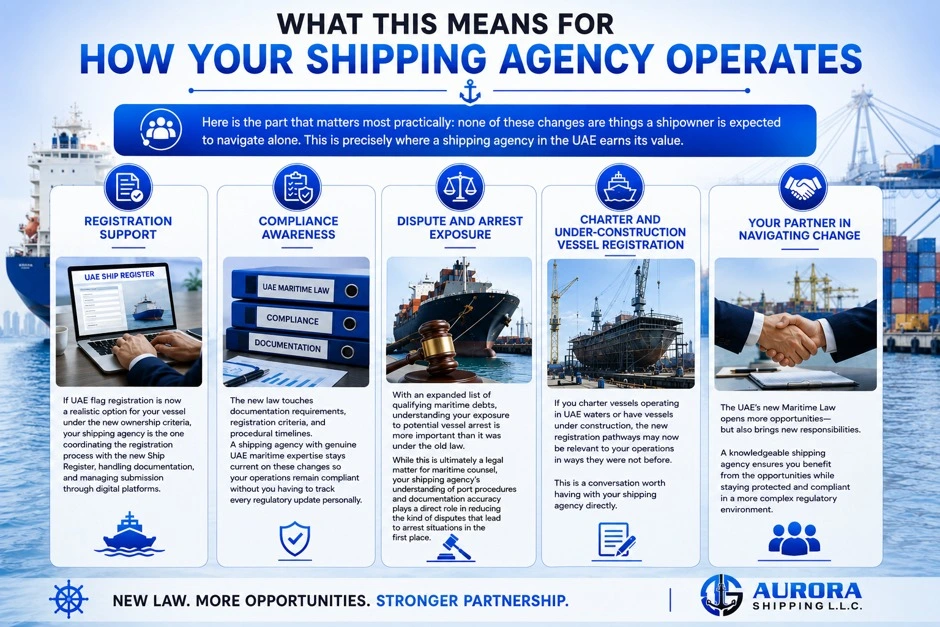
What This Means for How Your Shipping Agency Operates
Here is the part that matters most practically: none of these changes are things a shipowner is expected to navigate alone. This is precisely where a shipping agency in the UAE earns its value.
Registration support:
If UAE flag registration is now a realistic option for your vessel under the new ownership criteria, your shipping agency is the one coordinating the registration process with the new Ship Register, handling documentation, and managing submission through whatever digital platforms the Ministry rolls out.
Compliance awareness:
The new law touches documentation requirements, registration criteria, and procedural timelines. A shipping agency with genuine UAE maritime expertise stays current on these changes so your operations remain compliant without you having to track every regulatory update personally.
Dispute and arrest exposure:
With an expanded list of qualifying maritime debts, understanding your exposure to potential vessel arrest is more important than it was under the old law. While this is ultimately a legal matter for maritime counsel, your shipping agency's understanding of port procedures and documentation accuracy plays a direct role in reducing the kind of disputes that lead to arrest situations in the first place.
Charter and under-construction vessel registration:
If you charter vessels operating in UAE waters or have vessels under construction, the new registration pathways may now be relevant to your operations in ways they were not before. This is a conversation worth having with your shipping agency directly.
Why This Matters Beyond the Legal Detail
Strip away the legal specifics, and the bigger picture is this: the UAE is positioning itself as a serious, internationally competitive maritime jurisdiction. Wider registration eligibility, a modernised dispute resolution framework, and alignment with international arrest conventions are not isolated changes — they are part of a coordinated effort to make the UAE more attractive to global shipowners, charterers, and maritime investors.
That has knock-on effects across the entire sector. More vessels registering under the UAE flag mean more port activity. More international operators establishing UAE-based management structures mean more demand for local expertise — shipping agencies, crew manning, marine surveys, P&I support, and everything in between.
For shipowners already operating in the UAE, or considering it, this is a genuinely good moment to revisit how your operations are structured and whether the new regulatory environment opens up options that were not available to you before.
Frequently Asked Questions
When did the new UAE Maritime Law come into effect?
Federal Decree-Law No. 43 of 2023 came into effect on 29 March 2024, replacing the previous maritime law that had been in place since 1981.
Can foreigners now register a vessel under the UAE flag?
Yes, in a wider range of circumstances than before. Vessels can be registered if the majority of shares are owned by UAE or GCC nationals, or by entities with a domicile, head office, or ship management office in the UAE.
What is the new Ship Register?
It is a dedicated vessel registration authority under the Ministry of Energy and Infrastructure, replacing the previous Maritime Inspection Department and introducing digital registration platforms.
Can chartered vessels be registered under the UAE flag now?
Yes. Charterers of foreign-registered vessels can apply for UAE registration provided the charter party meets the minimum required duration and other registration conditions are satisfied.
How has the vessel arrest procedure changed under the new law?
The list of qualifying maritime debts has expanded, sister ship arrest is now recognised, and applicants seeking an arrest must provide financial security for crew and vessel maintenance costs during the arrest period.
Does a shipping agency help with vessel registration under the new law?
Yes. A shipping agency with UAE maritime experience coordinates registration documentation, liaises with the relevant authorities, and helps shipowners understand whether their vessel now qualifies for UAE registration under the expanded criteria.
Conclusion
Laws like this do not change overnight, and their real impact tends to show up gradually — in registration numbers, in how disputes get resolved, and in how many international operators decide the UAE is worth establishing a presence in. But the direction is clear. The UAE has built a more modern, more internationally aligned maritime legal framework, and that creates a genuine opportunity for shipowners who understand how to use it.
Navigating that shift, registration eligibility, documentation, port compliance, and day-to-day operational support is exactly what a shipping agency in the UAE is there for. The law has changed. The need for experienced, on-the-ground support to make sense of it has not.
Whether your focus is vessel registration, regulatory compliance, or protecting your fleet with trusted marine coatings and maintenance solutions, Aurora Shipping LLC brings everything together under one roof. By combining ship agency, marine services, and Hempel coatings, we provide a seamless, integrated solution without the complexity of managing multiple service providers.
If you are reassessing your vessel's registration options, chartering structure, or general compliance position under the new Maritime Law, the team at Aurora Shipping LLC is available to talk through what it means for your specific operations.