Shipping Agent vs Protecting Agent: What's the Real Difference?
Ask ten people in shipping to explain the difference between a shipping agent and a protecting agent, and you'll probably get ten slightly different answers. That's not because the distinction is unclear; it's because most people only ever deal with one of the two roles and never need to think about how they differ.
Here's the short version. A shipping agent runs the show at port, handling everything from paperwork to crew changes on behalf of the shipowner or charterer. A protecting agent isn't running anything; they're watching. Their job is to make sure whoever is running things is doing it properly, usually on behalf of whichever party isn't the one calling the operational shots.
That distinction matters most in ports like Dubai, Jebel Ali, and Abu Dhabi, where high shipment volume means a lot of moving parts, and a lot of room for one party's interests to quietly slip out of sync with another's.
So What Does a Shipping Agent Actually Handle?
Think of a shipping agent as the person making sure a vessel's entire port stay goes off without a hitch. That covers documentation, coordinating with customs and port authorities, arranging crew changes, managing cargo handling, and keeping ship supply running smoothly- essentially every operational thread that needs pulling together before a vessel can turn around and leave again. They handle this side of things directly for shipowners and charterers, coordinating the practical work of a port call from arrival paperwork through departure. It's a hands-on role. The agent isn't just observing the process; they're the one making it happen. That's precisely why this role, on its own, isn't built for independent oversight. Whoever's running the operation naturally has some stake in how it's judged, which is a fair, unavoidable limitation rather than a criticism.And What Does a Protecting Agent Actually Do?
A protecting agent steps in when there's a real chance that one party's interests might not get a fair shake through the standard shipping agent alone. Rather than managing the port call, they're checking that it's being managed correctly, on behalf of someone who isn't in the driver's seat. A lot of that oversight comes down to money. Port calls generate costs across dozens of line items, fees, services, and incidentals, and it's easy for charges to slip through without much scrutiny when only one party is watching. A protecting agent reviews those cost breakdowns and flags anything that looks off before it becomes a bigger dispute later. It's a quieter role than a shipping agent's, mostly reporting and verification rather than hands-on coordination, but it's the kind of quiet that saves people money and headaches down the line.Why Would Anyone Need Both at the Same Time?
Shipowners and charterers don't automatically want the same things out of a port call, even when nothing's technically gone wrong. A shipowner usually cares most about a fast, clean turnaround. A charterer tends to care more about whether the costs add up and the cargo's handled the way they expect. Most of the time those priorities overlap just fine. Occasionally they don't. When that gap shows up, running both a shipping agent and a protecting agent isn't overkill; it's just making sure each side actually has someone accountable to them specifically, instead of trusting one agent to represent two sets of interests at once. It's less about suspicion and more about how commercial shipping deals tend to work once real money and higher-value cargo are involved. Nobody's assuming bad faith. They're just building in a second set of eyes because that's standard practice, not a red flag.Does It Make Sense to Use One Provider for Both Roles?
It can, and often does work out better that way. Hiring two completely separate companies for shipping agency and protecting agency means introducing two sets of contacts, two communication styles, and twice the chance that something gets lost between them. Aurora Shipping offers both services, which means a shipowner and a charterer can each get proper, independent representation without the usual coordination headache of managing unrelated vendors. The protecting agent side still operates independently; that's the whole point, but having both functions under one roof tends to mean faster answers and fewer miscommunications. That's especially useful in situations where timing actually matters, since two disconnected providers can end up creating more confusion than they resolve.Has UAE Maritime Law Changed Anything Here?
Yes, and fairly recently. According to Chambers and Partners' Shipping 2026 guide, the UAE's Commercial Maritime Law underwent a significant update, replacing the older 1981 framework with rules better suited to how the shipping industry actually operates today. For shipowners and charterers, that shift touches things like vessel registration and how maritime claims get handled, which, indirectly, raises the value of having someone independently verifying a port call rather than relying entirely on one party's account of how things went. As regulation evolves, having a second, unaffiliated check on the process becomes more useful, not less.Shipping Agent vs Protecting Agent vs Using Both
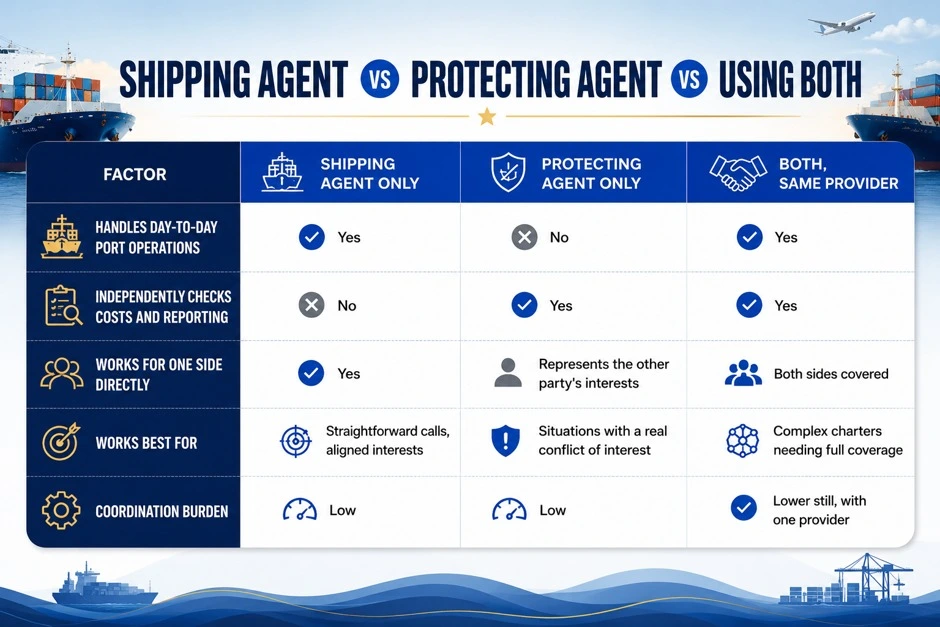
Frequently Asked Questions
Is a protecting agent basically the same as a shipping agent?
No. One runs the port call, the other checks that it's being run properly on someone else's behalf.
If I already have a shipping agent, do I still need a protecting agent?
Only if there's a real risk that the shipowner's and charterer's interests might not line up, particularly around costs or cargo handling.
What kind of things does a protecting agent actually look at?
Mostly cost breakdowns, port charges, and whether the appointed local agent is handling the call the way they should be.
Can the same company do both jobs?
Yes. Aurora Shipping is one example, handling shipping agency and protecting agency work independently, without forcing clients to juggle two separate vendors.
Who usually brings in a protecting agent, the owner or the charterer?
It depends on the deal, but it's typically whichever party isn't already represented by the vessel's main shipping agent.