Your cart is currently empty!
Category: Uncategorized
-

Shipping Agency in UAE: Why Consolidating Services Saves Time and Risk
Shipping Agency in UAE: Why Consolidating Services Saves Time and Risk
Most shipowners don’t set out to work with five different vendors for one port call. It just happens gradually, one contact for cargo, another for crew, a third for supply, and before long nobody has the full picture. A shipping agency in UAE exists to fix exactly that problem, pulling port coordination, documentation, crew services, cargo handling, and ship supply under one accountable team instead of scattering them across separate providers.
In ports as busy as Dubai, Jebel Ali, and Abu Dhabi, every extra vendor in that chain is another place where something can slip through the cracks.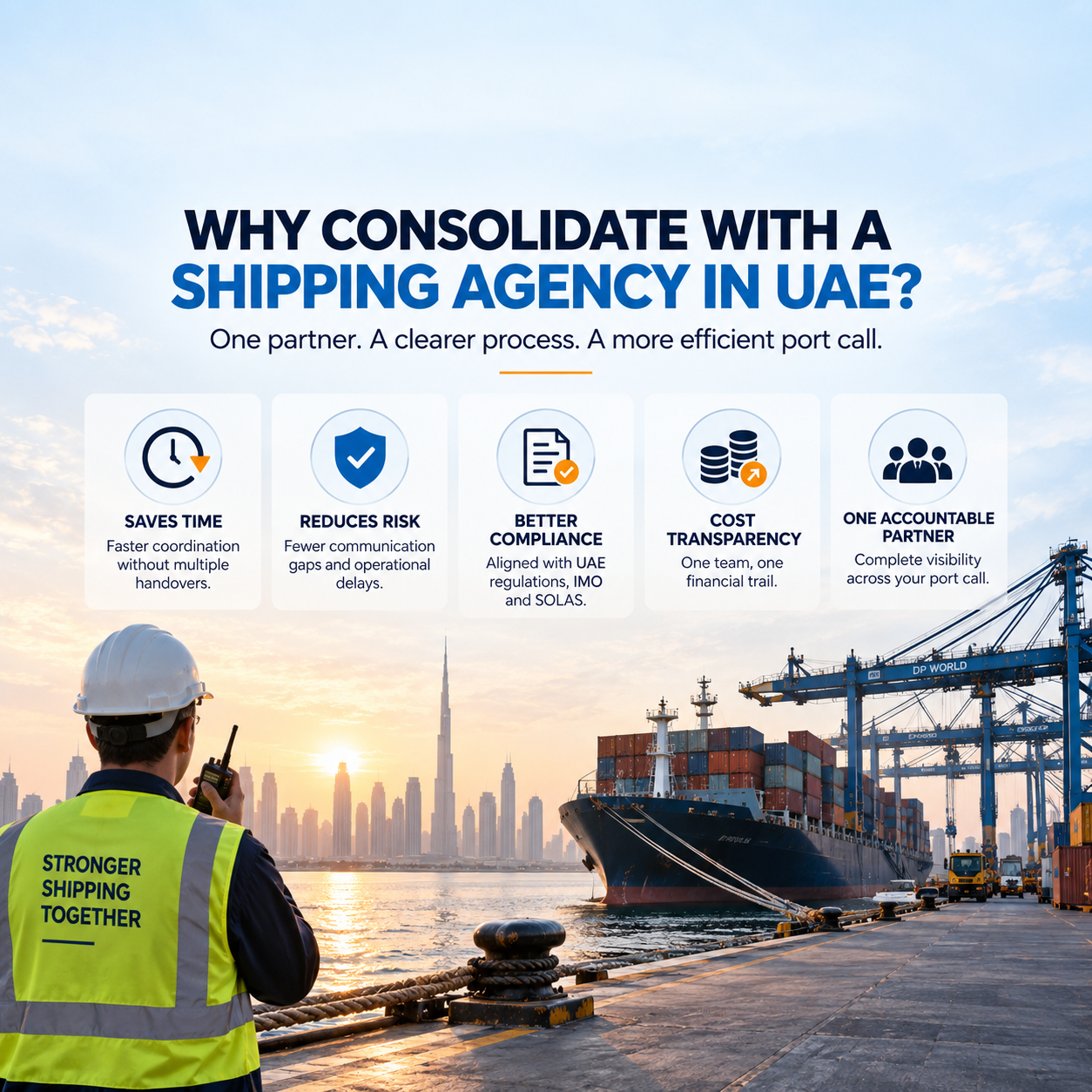
Benefits of consolidating shipping services with a shipping agency in UAE. What’s actually on a shipping agency’s plate?
More than most people assume. A shipping agency isn’t just the group that files paperwork; it’s managing the entire operational side of a port call, start to finish: coordination, documentation, crew, cargo, and supply, all at once.
Take cargo loading and discharging as one example. Someone has to make sure the quantities match what was agreed, the condition of the goods holds up, and the timeline stays on track. That means working directly alongside stevedores, terminal operators, and cargo surveyors, the core of any cargo service in the UAE, to ensure nothing leaves the vessel without proper sign-off.
When a single provider owns all of that, there’s one team you call when something needs an answer.
So why do some owners still split it across vendors?
Old habits, mostly. The industry’s traditionally worked this way: separate contacts for separate jobs, and for a simple, low-complexity call, that setup can limp along fine. The trouble starts once things get even slightly complicated.
Crew welfare is where this really shows its cracks. Visa arrangements, medical needs, repatriation — none of it is optional, and in the UAE specifically, immigration rules around crew are strict enough that a knowledgeable local agent isn’t a nice-to-have; it’s what keeps a small paperwork issue from becoming a real problem.
Spread that same job across three different vendors, and suddenly nobody has a clear picture of where a crew member’s paperwork actually stands. That gap, more often than not, is exactly where things go wrong.
What’s the actual cost of fragmenting port services?
Miscommunication, mostly, and it’s more expensive than it sounds. When no single provider sees the whole port call, small gaps open up. A shipment gets delayed not because anyone did their individual job badly, but because the handoff between the cargo team and the documentation team never quite happened.
There’s a financial angle too, and it’s not a small one. Freight rates have been volatile, operating costs keep climbing, and across the industry that’s putting real pressure on shipowners, operators, and charterers alike. Financial distress spreads quickly in that kind of environment, which makes cost transparency, and having someone actually watch the full picture, more important than it used to be.
Fragmented vendors also make billing errors harder to catch early, since nobody’s reviewing the complete financial trail of a port call from beginning to end. Everyone’s just looking at their own invoice.
Does consolidating actually save time, or is that just a sales line?
It genuinely does, and the reason is fairly simple: one team already has the context. They don’t need updates relayed from three other companies before they can make a call. When port coordination, crew, cargo, and supply all sit with one provider, information moves faster because it isn’t bouncing between outside teams first.
That speed matters most exactly when things go sideways:
- A crew visa stuck in processing.
- A cargo count that doesn’t add up.
- A berth conflict nobody saw coming.
A consolidated agency can react immediately, because the same people already understand the full situation, not a summary version of it.
Compliance holds up better under this model too. Is the provider, whether a protecting agency or a full port agent, actually licensed by UAE maritime authorities? Do they genuinely understand IMO regulations, SOLAS, and local port bylaws, or are they guessing? One well-versed team answers that consistently across everything they touch, instead of hoping five separate vendors each independently got it right.
Has anything changed legally that affects this?
Yes, and recently. Per Chambers and Partners’ Shipping 2026 guide, the UAE overhauled its Commercial Maritime Law, moving well past the old 1981 framework to something that actually reflects how the shipping industry operates today.
Practically, that touches:
- Vessel registration.
- How disputes get handled.
- The process around maritime claims.
An agency that’s keeping up with these changes puts a shipowner in a stronger position, particularly when compliance is built into a consolidated service rather than bolted on as an afterthought by whichever vendor happens to be paying attention that week.
One agency vs. several vendors: a quick look
Factor Single Shipping Agency Multiple Separate Vendors Communication One team, centralized visibility Coordinated across separate points of contact Response speed Fast, since context is shared internally Depends on how well vendors coordinate with each other Regulatory compliance Standardized across all services by one provider Each vendor manages compliance independently Disbursement transparency Single consolidated invoice Multiple itemized invoices from each vendor Crew welfare coordination Managed by one team across all touchpoints Managed separately by each specialized vendor Cost structure May include hub or coordination fees Allows comparing and negotiating rates across vendors Why go with one shipping agency instead of juggling several vendors?
Because one team keeps full visibility across port coordination, crew, cargo, and documentation, and that alone tends to save time and cut down on avoidable risk.
What does a shipping agency actually cover during a port call?
Port coordination, documentation, crew services, cargo handling, and ship supply, all managed together so the turnaround stays on schedule.
How exactly does splitting services across vendors increase risk?
Nobody has the full picture. A handoff gets missed between two providers who each did their own job fine, and the shipment stalls anyway.
Is crew welfare genuinely part of what a shipping agency does?
Yes, and it’s a bigger part than people expect: visas, medical needs, repatriation, especially given how strict UAE crew immigration rules are.
What’s worth checking before picking a shipping agency?
Whether they’re properly licensed, whether their disbursement accounts are actually transparent, and whether they’re reachable 24/7, since problems at sea don’t wait for office hours.
One team, fewer gaps
At its core, the case for consolidating shipping agency services is about accountability. When one provider handles coordination, crew, cargo, and documentation together, there’s nowhere for information to disappear, and no confusion about who picks up the phone when something needs to move fast. That matters more, not less, as UAE ports get busier and the regulatory landscape keeps shifting under everyone’s feet.
Based at Dubai Maritime City, Aurora Shipping LLC handles full shipping agency work: port coordination, documentation, crew services, cargo handling, and ship supply. That gives shipowners one accountable team across Dubai, Jebel Ali, and Abu Dhabi instead of a patchwork of vendors who’ve never spoken to each other.
-

Yacht Services in Dubai: How the Market Changed in 2026
Yacht Services in Dubai: How the Market Changed in 2026
Yacht services in Dubai have undergone a significant structural shift in 2026, driven by a new inter-emirate maritime protocol, record superyacht activity, and a UAE yacht industry valued at approximately USD 136 million and projected to reach USD 174.9 million by 2033 (INTLBM, May 2026). Dubai’s marinas, including Dubai Marina and Jebel Ali, now operate year-round at a pace that demands more from every yacht service provider operating in UAE waters.
For yacht owners and charter operators, that shift is not just a headline. It changes what professional yacht services in Dubai need to deliver and what distinguishes a capable provider from one simply keeping up.
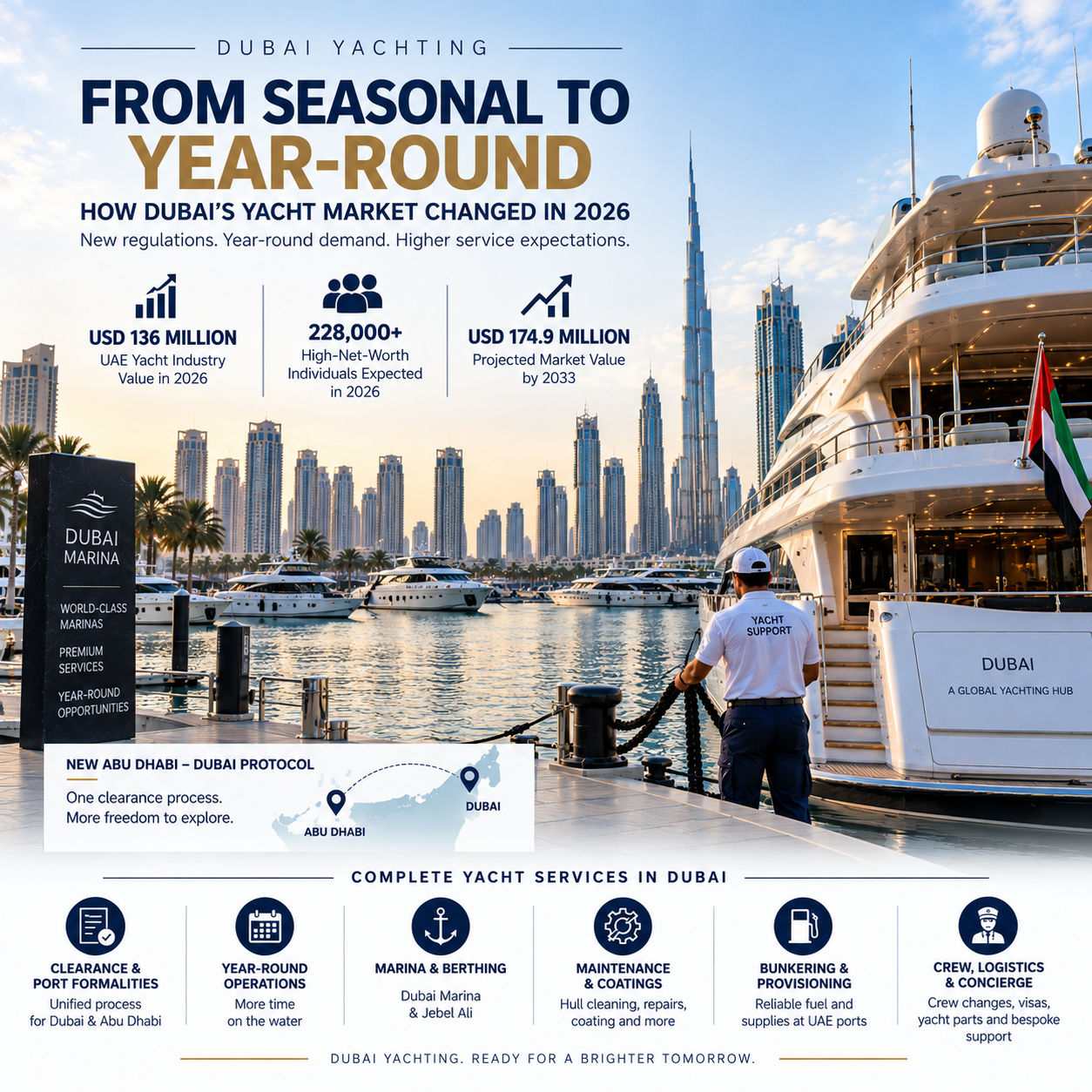
Dubai yacht services supporting year-round operations, marina berthing, maintenance, bunkering and crew logistics. How much has the UAE yacht market actually grown?
It’s no longer a niche regional story. The industry’s current valuation of roughly USD 136 million, projected to reach USD 174.9 million by 2033 according to INTLBM’s May 2026 figures, is being driven by three factors in particular.
The first is people. Super Yacht News reported back in February that the UAE is on track to welcome more than 228,000 high-net-worth individuals this year, and a large share of them either own a yacht outright or charter one regularly — which means their expectations around service quality tend to be as high as everything else in their lives.
The second is infrastructure. Dubai Marina and Jebel Ali have long been the go-to berthing spots for private and commercial vessels, but Dubai Harbour’s ongoing 700-berth expansion is what’s really changing the math. There’s now enough physical capacity to run superyacht operations year-round rather than cramming everything into six months.
The third is simply where the money’s going globally. The DIBS 2026 industry briefing put the worldwide superyacht market at USD 11.11 billion this year, climbing past USD 16.6 billion by 2034, and Dubai is angling for a bigger slice of that pie than it’s ever had before.
What this actually means on the ground: more requests, more complexity, and owners who show up expecting the same level of coordination they’d get from a five-star concierge desk.
What changed with the new Abu Dhabi–Dubai protocol?
If you want the single biggest operational shift of the year, it’s this one. In January 2026, Abu Dhabi and Dubai rolled out a unified maritime framework that got rid of the inter-emirate paperwork foreign-flagged yachts used to deal with (Travel and Tour World reported on this back in December 2025).
Before the change, moving a foreign-flagged yacht between the two emirates meant repeating clearance procedures, annoying enough that it discouraged owners from staying longer or building flexible itineraries.
- One clearance process covers both emirates.
- Owners are staying longer, since there’s no longer a paperwork penalty for splitting time between Dubai and Abu Dhabi.
- Longer stays mean more spending on bunkering and provisioning locally.
The UAE government specifically flagged shipping agents and yacht service providers as the parties who stand to benefit most. Practically speaking, if you’re planning an extended UAE itinerary this year, working with a provider that’s already comfortable operating under the new framework isn’t a nice-to-have anymore; it’s the baseline.
Is Dubai really a year-round destination now?
Yes, and it’s a real departure from how things worked even two years ago. SuperyachtNews’ February piece makes the point plainly: Dubai has become a genuine year-round superyacht hub rather than a winter substitute for the Mediterranean.
The clearest sign of that is the boat show itself. The Dubai International Boat Show has permanently moved to a November slot on the calendar, a scheduling change the DIBS 2026 briefing describes as reinforcing Dubai and the wider UAE’s position as a strategic hub for marine leisure.
For anyone running yacht services, that has a few knock-on effects:
- Berths at Dubai Marina and Jebel Ali need to be booked with more lead time than you’d expect in a seasonal market.
- Maintenance windows are now spread across the calendar instead of clustering before peak season.
- Crew logistics, visas, transfers, and crew changes run continuously rather than in seasonal bursts.
For owners, the takeaway is that a good yacht service provider in Dubai needs to function as a permanent resource, not something you dust off every October.
What do owners actually need from a Dubai yacht service provider in 2026?
The list has grown well past basic berthing and provisioning. Here’s roughly what’s expected across the board these days:
- Clearance and port formalities:
Under the new protocol, this now covers Dubai and Abu Dhabi together. Get the documentation wrong, and there’s very little room for correction once the vessel’s already announced. - Marina and berthing:
Dubai Marina and Jebel Ali both require planning and, frankly, relationships with the marina operators; competition for good berths gets fierce between October and April. - Maintenance coordination:
Hull cleaning, engine work, electrical servicing, generators, polishing, painting — all of it needs to be scheduled around the boat’s actual itinerary, not the calendar. - Duty-free bunkering:
Fuel through reliable local suppliers, timed around port operations and the vessel’s movements. - Crew handling and visa:
International crew needs immigration support, visa processing, transfers, and housing sorted the first time correctly; UAE immigration doesn’t leave much margin for error. - Concierge and VIP support:
This has moved past basic hospitality. Hotel bookings, private transfers, restaurant reservations, provisioning — owners now treat these as standard, not extras. - Antifouling and coating:
UAE waters are hard on hulls. Providers with direct access to certified products, Hempel Marine Paints, for instance, can do work that generalist providers simply can’t match. - Freight and logistics:
Spare parts and supplies arriving from overseas need customs clearance and last-mile delivery to the vessel. A provider that can handle cargo and yacht operations under one roof saves a lot of back-and-forth.
2024 vs. 2026: what’s actually different
Factor 2024 2026 Operating season Mostly October–April Year-round Inter-emirate movement Separate paperwork per emirate One clearance under the unified protocol Main UAE berths Dubai Marina, Jebel Ali Same locations, much higher occupancy Superyacht activity Growing UAE now has the highest superyacht-to-billionaire ratio globally Coating & maintenance demand Seasonal peaks Continuous, needs advance scheduling Concierge expectations Standard hospitality Personalised, real-time, VIP-level Crew logistics Periodic changes Continuous rotation, ongoing visa work Market value ~USD 120 million USD 136 million (INTLBM, 2026) The move from a seasonal to a year-round market is the change that matters most. It weeds out providers who scale up for winter and coast the rest of the year; that model doesn’t really work anymore.
What should you expect from a provider this year?
A handful of things, really:
- Actual local knowledge — of UAE maritime procedure, the new inter-emirate protocol, and how Dubai Marina and Jebel Ali operate day to day. This comes from years in the water, not a brochure.
- Round-the-clock availability — because year-round yachting means requests don’t stop at 6 pm. Schedules shift overnight, maintenance issues pop up on weekends, and a provider who isn’t reachable isn’t really a full-service option anymore.
- Technical coating capability — access to certified products like Hempel Marine Paints matters more as the superyacht fleet in Dubai grows and hull conditions get more demanding.
- Logistics that actually connect — customs clearance, documentation, and cargo handled by the same team managing the yacht, rather than three separate vendors who don’t talk to each other.
- Crew coordination that understands both sides — maritime operations and UAE immigration rules, so crew changes go smoothly even as rotation frequency picks up.
Frequently asked questions
How has the Dubai yacht market changed in 2026?
It’s grown to roughly USD 136 million, pushed by superyacht demand, the new Abu Dhabi–Dubai protocol, and year-round activity at Dubai Marina and Jebel Ali.
What’s the new UAE yacht protocol about?
Starting January 2026, a unified framework between Abu Dhabi and Dubai did away with separate paperwork for foreign-flagged yachts moving between the two emirates; now it’s one clearance process for both.
Is Dubai a year-round yachting destination now?
Yes. It’s moved past its old October–April season, and the Dubai International Boat Show permanently shifting to November is a good sign of how established that shift has become.
What yacht services are actually available in Dubai right now?
Clearance and port formalities, berthing, maintenance, duty-free bunkering, crew visa support, VIP concierge, certified antifouling and coating work, and freight logistics for parts and supplies.
How do you find a reliable provider?
Look for verified UAE maritime experience, genuine 24/7 availability, access to certified marine coatings, logistics that are actually integrated rather than outsourced, and crew coordination that covers visas properly.
Choosing a Provider That Matches the Market
Dubai’s yacht services market in 2026 is bigger and less forgiving than it’s ever been. Year-round demand, a simpler inter-emirate protocol, a wave of high-net-worth arrivals, and a market now worth USD 136 million have all raised the bar for what “good service” means in UAE waters.
For owners, the real question is simple: can your current provider actually keep up with that? A provider worth using needs marina expertise at Dubai Marina and Jebel Ali, a working knowledge of the 2026 protocol, solid crew coordination, real technical maintenance capability, certified Hempel coating access, and logistics support that doesn’t fall apart at customs, delivered consistently, not just when it’s convenient.
Aurora Shipping LLC, based at Dubai Maritime City, covers all of that from berthing and clearance through to Hempel-certified antifouling and VIP concierge support, around the clock.
-
Cargo Service in the UAE: Why Reliability Matters More in 2026
Cargo Service in the UAE: Why Reliability Matters More in 2026
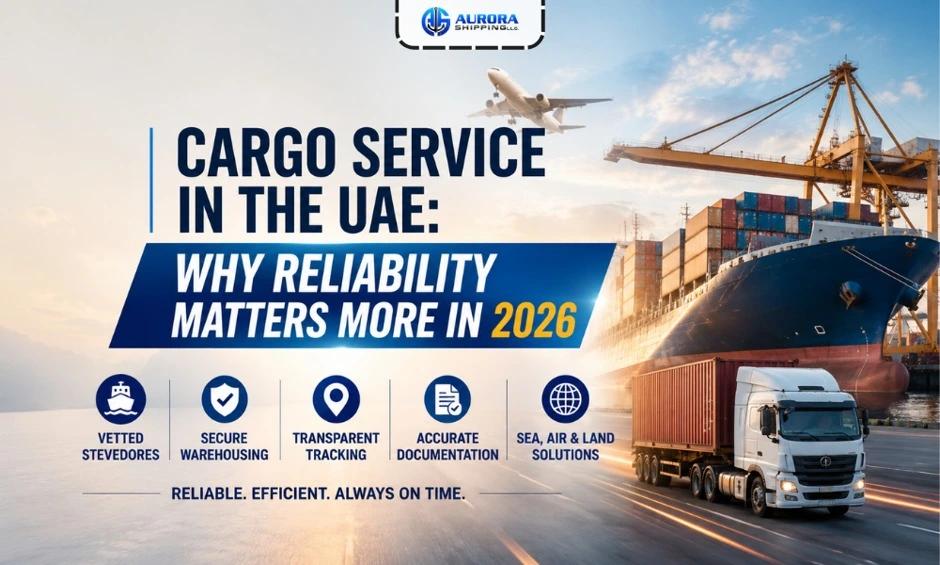
Cargo service in the UAE covers everything involved in moving freight through the country’s ports, airports, and warehouses: booking capacity, handling documentation, clearing customs, and physically getting goods from one point to the next. Dubai, Abu Dhabi, and the broader Gulf region move an enormous volume of trade every year, and in 2026 that volume is only climbing. A single documentation error or a missed customs window can hold up a shipment for days, which is why reliability has quietly become the main thing businesses screen for when they pick a cargo partner.
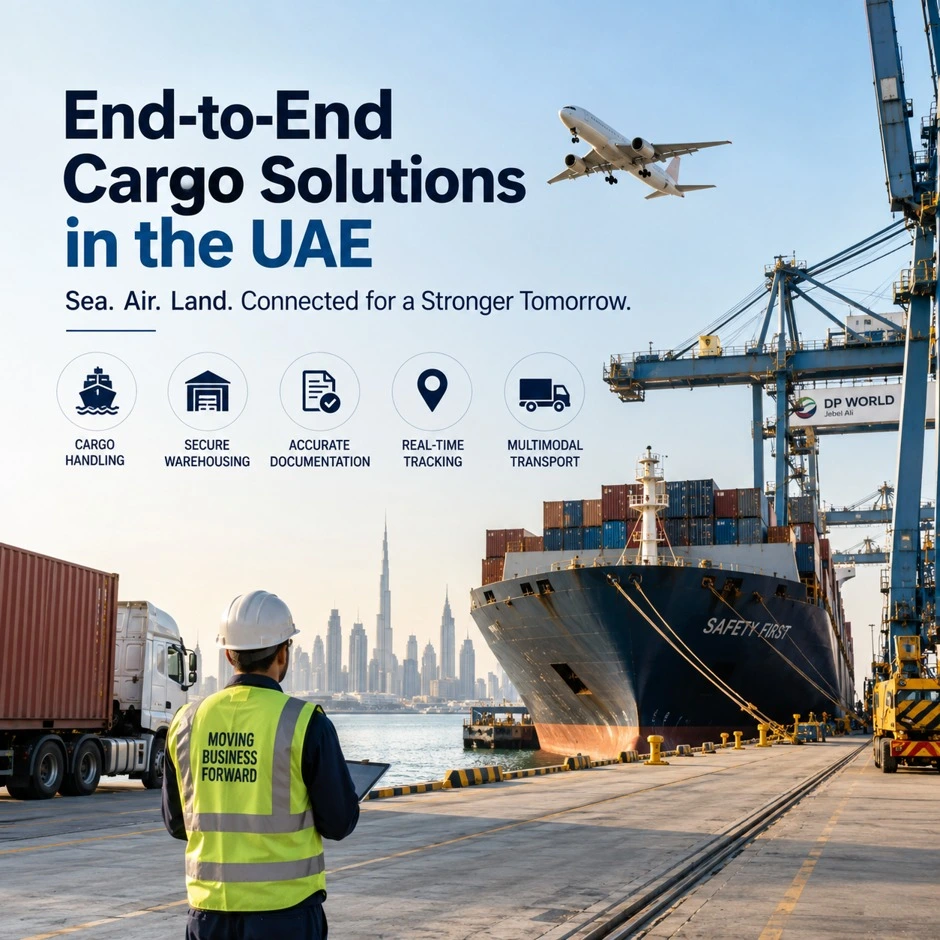
Reliable end-to-end cargo solutions across the UAE through sea, air, and land transportation. Why UAE Businesses Are Prioritizing Reliability Over Price in 2026
Cost used to be the first question shippers asked. It’s slipping to second place.
The UAE freight and logistics market was valued at roughly USD 23.05 billion in 2026, and Mordor Intelligence projects it will reach USD 31.63 billion by 2031. That kind of growth sounds like good news for everyone, and mostly it is, but it also means more vessels competing for the same berth slots, more trucks on the same highways, and more shipments funneling through the same customs desks. When capacity gets tighter, the providers who plan pull away from the ones who don’t.
For a business owner, this shows up in a very unglamorous way: a shipment that sits at customs for three extra days because a form was filled in wrong. It doesn’t make headlines, but it costs money, and it costs trust with your own customers. That’s the real reason “reliable” has become the word every logistics provider now puts in their tagline: because the businesses that’ve been burned once are done gambling on it.
Cargo Service, Shipping Agency, Freight Forwarding — They’re Not the Same Thing
People use these terms interchangeably, and that’s part of the problem.
Cargo service is the physical side, handling, warehousing, and moving goods. Shipping agency is about the vessel itself: representing it at port, managing crew changes, dealing with the port authority. Freight forwarding sits above both, stitching together the full transport plan and the carrier bookings across however many legs a shipment needs.
When these functions are split across three different vendors, someone has to manage the handoffs between them, and handoffs are where delays creep in. Aurora Shipping runs all three under one team, so cargo handling stays tied directly to shipping agency services instead of getting passed between companies that don’t talk to each other.
What Really Makes a Cargo Service Provider Stand Out?
Reliable cargo transportation is about more than simply moving goods from one location to another. The right logistics partner should provide efficient coordination, clear communication, secure handling, and visibility throughout the shipment journey.
Before choosing a cargo service provider, consider:
- Port Handling: Are your shipments managed by experienced and vetted stevedores?
- Shipment Tracking: Do you receive transparent tracking and regular shipment updates?
- Documentation Support: Is your cargo documentation handled accurately and efficiently?
- Multimodal Transport: Can the provider coordinate air, sea, and land cargo movement?
- Additional Oversight: Is protecting agency support available for high-value or contested cargo operations?
A reliable cargo service provider should combine professional cargo handling, secure warehousing, freight coordination, documentation support, and transparent reporting to help businesses maintain efficient and reliable logistics operations.
The Real Reasons Cargo Gets Delayed at UAE Ports
Most delays aren’t dramatic. They’re small and preventable.
Documentation mismatches are the usual culprit: a name spelled slightly differently across two forms, a missing stamp, a code that doesn’t match the manifest. Customs authorities don’t negotiate on this; the shipment sits until it’s fixed, and every day it sits costs storage fees on top of the delay itself.
Volume adds pressure on top of that. Jebel Ali Port alone handled 15.5 million TEUs in 2024, and Dubai International processed 2.2 million tonnes of cargo the same year, according to Ken Research’s UAE Logistics Market report. At that scale, a provider who submits paperwork early and stays in direct contact with customs has a real edge over one who waits until the shipment lands before starting to sort things out.
Sea, Air, or Land — Which One Actually Fits Your Shipment
This isn’t really a “which is best” question. It’s a “what are you shipping and how fast do you need it” question.
Factor
Sea Cargo
Air Cargo
Land Cargo
Best for
Bulk, containerized, project cargo
Time-critical, high-value goods
Regional GCC deliveries
Typical speed
Days to weeks
Hours to 1–2 days
Hours to 2–3 days
Cost per unit
Lowest
Highest
Moderate
Volume capacity
Very high
Limited by aircraft space
Moderate, truck-dependent
UAE hub example
Jebel Ali Port
Dubai International cargo terminal
Cross-GCC highway network
If you’re moving heavy or bulky freight and price matters more than speed, sea is the obvious call. If it’s perishable, pharmaceutical, or genuinely can’t wait, air earns its higher cost. And if the destination is somewhere else in the GCC, land freight usually beats both on convenience. Most businesses end up using all three at different points, which is exactly why it helps to work with a provider who runs them from one desk instead of juggling three separate vendors.
How Aurora Shipping Actually Handles This
Aurora Shipping’s setup is simple in concept: cargo handling, shipping agency, protecting agency, and marine services all sit under one roof across Dubai, Jebel Ali, and Abu Dhabi. That means one shipment touches one team, not four contractors who each need separate updates.
In practice, that looks like vetted stevedores handling containerized and project cargo, a 24/7 desk for the port calls that always seem to come up outside business hours, and protecting agency oversight available when a shipment’s value or complexity calls for extra scrutiny.
For shipments that need vessel-side coordination too, Aurora Shipping’s marine services cover classification, surveys, and flag registration alongside the cargo work itself — so that side of things doesn’t need a separate provider either.
Frequently Asked Questions
What cargo services does Aurora Shipping provide in the UAE?
Commercial cargo transportation, freight coordination, customs documentation assistance, import-export logistics support, and warehousing across UAE ports.
What makes Aurora Shipping the best cargo service in the UAE?
etted stevedores, secure warehousing, and transparent, trackable reporting on every shipment, paired with direct coordination between the shipping agency and protecting agency teams.
Who certifies an IHM once it’s completed?
You get transparent tracking and reporting throughout the process, from berth to final delivery, not just answers when you call to check.
How is cargo service different from shipping agency at Aurora Shipping?
Cargo service handles the physical movement of goods; shipping agency manages the vessel’s port call and documentation. Aurora Shipping runs both under one team so nothing falls between the cracks.
What if my shipment is time-sensitive?
Aurora Shipping coordinates air, sea, and land cargo and keeps a 24/7 operations desk running for exactly this situation.
Moving Cargo Is Easy. Moving It Reliably Is What Matters.
Reliability in UAE cargo service isn’t a marketing word anymore; it’s the difference between a shipment that clears on schedule and one that sits racking up storage fees while your customer waits. As trade volumes continue to climb through 2026, the providers who plan ahead and coordinate everything under one roof are the ones businesses keep coming back to.
Aurora Shipping brings cargo handling, shipping agency, and protection agency support together across Dubai, Jebel Ali, and Abu Dhabi. Get in touch to talk through a cargo plan for your next shipment.
-
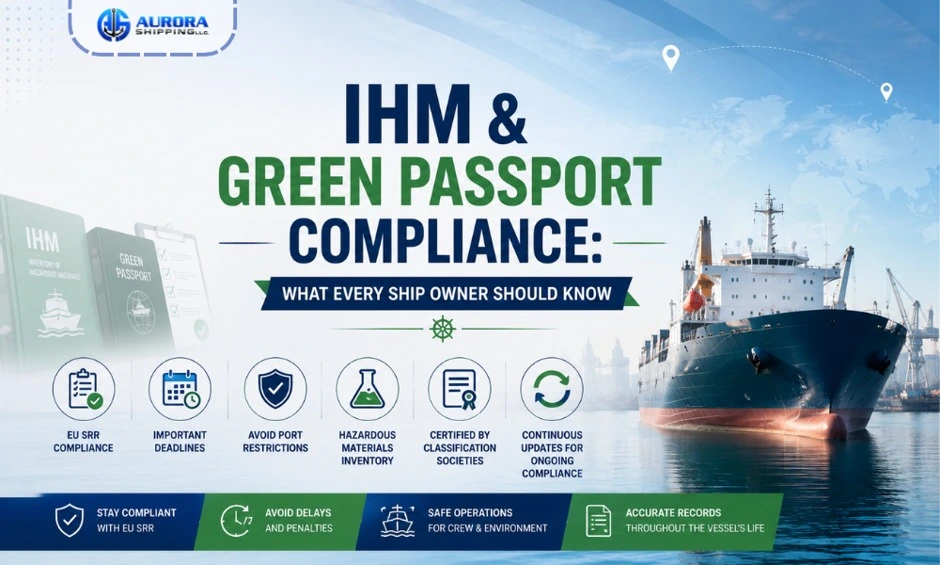
IHM & Green Passport Compliance: What Every Ship Owner Should Know
IHM & Green Passport Compliance: What Every Ship Owner Should Know
IHM stands for Inventory of Hazardous Materials, a certified record of every hazardous substance present in a vessel’s structure, equipment, and systems, while Green Passport is the earlier term for the same concept, first introduced by class societies before the IMO standardized it under the term IHM. Ship owners operating vessels of 500 gross tonnage and above need a valid, certified IHM to enter EU and EFTA ports. Understanding the difference between the two terms, and what compliance actually requires, matters for any owner managing a vessel operating in or near European waters.What Is IHM (Inventory of Hazardous Materials)?
An IHM is a certified inventory listing every known hazardous material on board a vessel, including substances like asbestos, PCBs, and certain heavy metals found in a ship’s construction, equipment, and systems. The inventory identifies these materials so crew members stay safe during the vessel’s operational life and so maintenance and repair work can proceed with full knowledge of what’s on board. A certified surveyor typically boards the vessel, collects material samples, and sends them to accredited laboratories for analysis. Based on those results, the inventory is compiled and certified by an approved classification society, such as DNV GL, ABS, or Lloyd’s Register.What Is a Green Passport, and How Does It Relate to IHM?
Green Passport was the original term used for this hazardous materials record, introduced by classification societies before the concept and the terminology were formalized under IMO guidelines as IHM. In practice, the two terms describe the same underlying document, and most of the industry has shifted to using IHM as the standard reference. Ship owners searching for either term are typically looking for the same service: certified identification, documentation, and ongoing maintenance of a vessel’s hazardous materials record.Which Ships Actually Need IHM Certification?
Any vessel above 500 gross tonnage flying an EU flag, or calling at EU and EFTA ports, needs a certified IHM under the EU Ship Recycling Regulation, in force since 31 December 2013. That IHM must be continuously updated throughout the vessel’s operational life, not just prepared once and filed away. Owners should also know the regulation didn’t apply to every vessel at once; it rolled out in stages. Newbuild vessels fell under the requirement first, starting 31 December 2018. Existing vessels then had until 31 December 2020 to catch up and get their own IHM in place. Miss that window entirely, and a vessel can simply be turned away, denied entry or anchorage at EU and EFTA ports until the documentation is sorted.What Happens If a Vessel Doesn’t Have a Valid IHM?
A vessel without a certified, up-to-date IHM faces real operational consequences, not just a paperwork gap. Ships lacking valid documentation can be denied entry or anchorage at EU and EFTA ports, which can disrupt schedules and add unplanned costs. Beyond port access, an outdated or incomplete IHM complicates maintenance and repair work, since accurate hazardous materials data is what allows those activities to proceed safely and in line with regulatory standards.Why Does IHM Documentation Need Continuous Updates?
A vessel’s hazardous materials record isn’t static, since equipment gets replaced, repairs happen, and new components are installed throughout a ship’s operational life. Each of those changes can introduce or remove hazardous materials from the inventory, meaning the original IHM can go out of date without anyone noticing until an inspection flags it. Keeping the IHM current means every material change is logged and reflected in the certified documentation, so the record stays accurate whenever it’s checked, whether that’s during a routine port call or a compliance audit.EU SRR Compliance at a Glance
EU SRR compliance comes down to a few key facts: who it applies to, when it took effect, and what happens if a vessel falls behind. Here’s the full requirement broken down at a glance.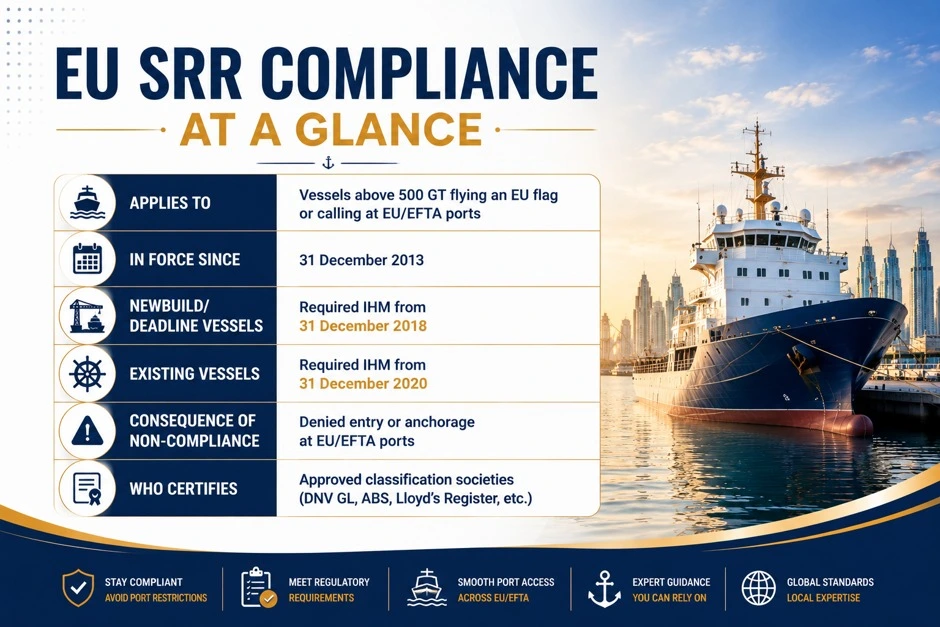
EU Ship Recycling Regulation (EU SRR) compliance requirements, IHM deadlines, and consequences of non-compliance. Staying on top of these dates is what keeps a vessel moving instead of stuck waiting on paperwork at port.Frequently Asked Questions
What’s the difference between IHM and Green Passport?
They refer to the same underlying document. Green Passport was the earlier industry term, while IHM is the standardized terminology now used under IMO and EU regulations.Which vessels are required to have a certified IHM?
Any vessel above 500 gross tonnage flying an EU flag, or calling at EU or EFTA ports, under the EU Ship Recycling Regulation.Who certifies an IHM once it’s completed?
Approved classification societies, such as DNV GL, ABS, or Lloyd’s Register, certify the inventory after survey and laboratory analysis are complete.What happens if a ship arrives at port without a valid IHM?
The vessel risks being denied entry or anchorage, along with complications for any maintenance or repair activity that depends on accurate hazardous materials data.Why does an IHM need to be updated regularly, rather than done once?
Equipment changes, repairs, and new installations can alter a vessel’s hazardous materials profile, so the inventory needs to be updated to remain accurate throughout the ship’s operational life.Staying Ahead of IHM and Green Passport Requirements
IHM and Green Passport compliance isn’t a one-time certificate to file away; it’s a continuously updated record that has to keep pace with a vessel’s changes and the regulations tied to it. Owners who plan ahead of deadlines, rather than reacting to them, avoid the operational disruptions that come with last-minute compliance scrambles. Aurora Shipping provides IHM and Green Passport services for ship owners and managers, organizing survey work, documentation, and ongoing updates so that vessel records remain accurate and compliant with EU SRR requirements throughout their operational life, keeping owners ahead of requirements rather than reacting to them. -
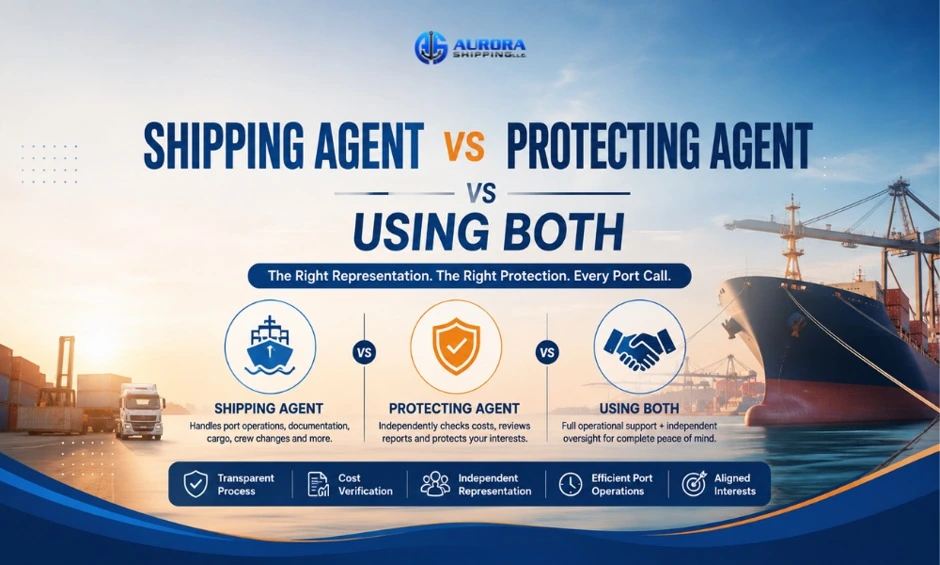
Shipping Agent vs Protecting Agent: What's the Real Difference?
Shipping Agent vs Protecting Agent: What’s the Real Difference?
Ask ten people in shipping to explain the difference between a shipping agent and a protecting agent, and you’ll probably get ten slightly different answers. That’s not because the distinction is unclear; it’s because most people only ever deal with one of the two roles and never need to think about how they differ. Here’s the short version. A shipping agent runs the show at port, handling everything from paperwork to crew changes on behalf of the shipowner or charterer. A protecting agent isn’t running anything; they’re watching. Their job is to make sure whoever is running things is doing it properly, usually on behalf of whichever party isn’t the one calling the operational shots. That distinction matters most in ports like Dubai, Jebel Ali, and Abu Dhabi, where high shipment volume means a lot of moving parts, and a lot of room for one party’s interests to quietly slip out of sync with another’s.So What Does a Shipping Agent Actually Handle?
Think of a shipping agent as the person making sure a vessel’s entire port stay goes off without a hitch. That covers documentation, coordinating with customs and port authorities, arranging crew changes, managing cargo handling, and keeping ship supply running smoothly- essentially every operational thread that needs pulling together before a vessel can turn around and leave again. They handle this side of things directly for shipowners and charterers, coordinating the practical work of a port call from arrival paperwork through departure. It’s a hands-on role. The agent isn’t just observing the process; they’re the one making it happen. That’s precisely why this role, on its own, isn’t built for independent oversight. Whoever’s running the operation naturally has some stake in how it’s judged, which is a fair, unavoidable limitation rather than a criticism.And What Does a Protecting Agent Actually Do?
A protecting agent steps in when there’s a real chance that one party’s interests might not get a fair shake through the standard shipping agent alone. Rather than managing the port call, they’re checking that it’s being managed correctly, on behalf of someone who isn’t in the driver’s seat. A lot of that oversight comes down to money. Port calls generate costs across dozens of line items, fees, services, and incidentals, and it’s easy for charges to slip through without much scrutiny when only one party is watching. A protecting agent reviews those cost breakdowns and flags anything that looks off before it becomes a bigger dispute later. It’s a quieter role than a shipping agent’s, mostly reporting and verification rather than hands-on coordination, but it’s the kind of quiet that saves people money and headaches down the line.Why Would Anyone Need Both at the Same Time?
Shipowners and charterers don’t automatically want the same things out of a port call, even when nothing’s technically gone wrong. A shipowner usually cares most about a fast, clean turnaround. A charterer tends to care more about whether the costs add up and the cargo’s handled the way they expect. Most of the time those priorities overlap just fine. Occasionally they don’t. When that gap shows up, running both a shipping agent and a protecting agent isn’t overkill; it’s just making sure each side actually has someone accountable to them specifically, instead of trusting one agent to represent two sets of interests at once. It’s less about suspicion and more about how commercial shipping deals tend to work once real money and higher-value cargo are involved. Nobody’s assuming bad faith. They’re just building in a second set of eyes because that’s standard practice, not a red flag.Does It Make Sense to Use One Provider for Both Roles?
It can, and often does work out better that way. Hiring two completely separate companies for shipping agency and protecting agency means introducing two sets of contacts, two communication styles, and twice the chance that something gets lost between them. Aurora Shipping offers both services, which means a shipowner and a charterer can each get proper, independent representation without the usual coordination headache of managing unrelated vendors. The protecting agent side still operates independently; that’s the whole point, but having both functions under one roof tends to mean faster answers and fewer miscommunications. That’s especially useful in situations where timing actually matters, since two disconnected providers can end up creating more confusion than they resolve.Has UAE Maritime Law Changed Anything Here?
Yes, and fairly recently. According to Chambers and Partners’ Shipping 2026 guide, the UAE’s Commercial Maritime Law underwent a significant update, replacing the older 1981 framework with rules better suited to how the shipping industry actually operates today. For shipowners and charterers, that shift touches things like vessel registration and how maritime claims get handled, which, indirectly, raises the value of having someone independently verifying a port call rather than relying entirely on one party’s account of how things went. As regulation evolves, having a second, unaffiliated check on the process becomes more useful, not less.Shipping Agent vs Protecting Agent vs Using Both
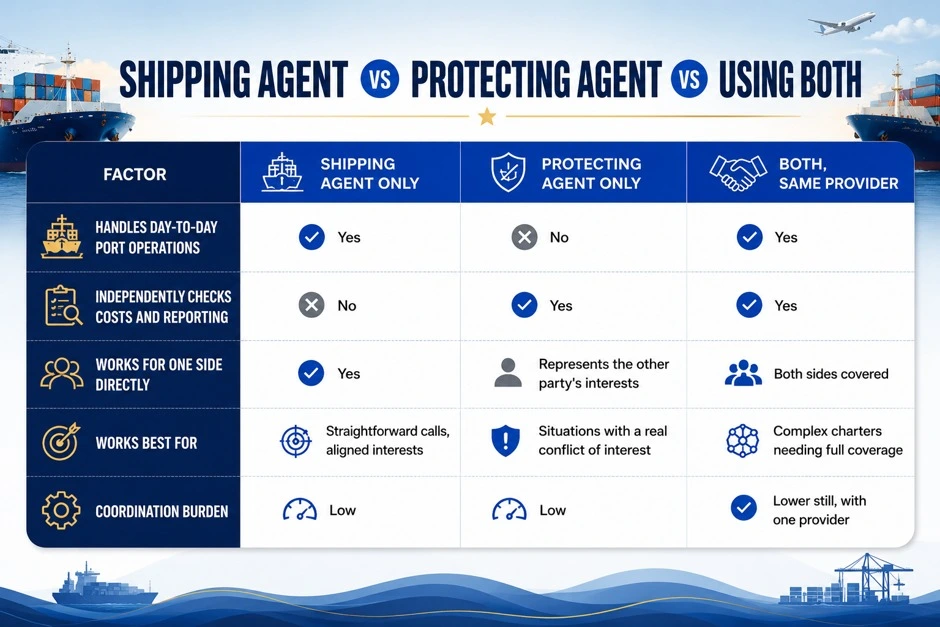
A comparison of shipping agents, protecting agents, and using both for effective vessel and port operation management. Frequently Asked Questions
Is a protecting agent basically the same as a shipping agent?
No. One runs the port call, the other checks that it’s being run properly on someone else’s behalf.If I already have a shipping agent, do I still need a protecting agent?
Only if there’s a real risk that the shipowner’s and charterer’s interests might not line up, particularly around costs or cargo handling.What kind of things does a protecting agent actually look at?
Mostly cost breakdowns, port charges, and whether the appointed local agent is handling the call the way they should be.Can the same company do both jobs?
Yes. Aurora Shipping is one example, handling shipping agency and protecting agency work independently, without forcing clients to juggle two separate vendors.Who usually brings in a protecting agent, the owner or the charterer?
It depends on the deal, but it’s typically whichever party isn’t already represented by the vessel’s main shipping agent.Making the Right Call for Your Port Call
Whether a vessel needs a shipping agent, a protecting agent, or both really comes down to how aligned the parties involved actually are. A shipping agent keeps things moving, handling the practical work that gets a vessel through port and back out to sea on schedule. A protecting agent makes sure that movement is honest and well-documented, working quietly in the background so nothing slips through unchecked. Neither one is more important than the other; they’re just solving different problems for different people. For a lot of vessels, one agent covering the operational side is genuinely enough. There’s no conflict to manage, no reason to bring in a second set of eyes, and adding one would just create extra cost and coordination for no real benefit. But once real money, higher-value cargo, or longer-term charter agreements enter the picture, that calculation tends to shift. The cost of a protecting agent is usually small compared to what an unnoticed billing error or an unclear port report can end up costing later. The good news is that figuring out which situation applies doesn’t have to be complicated, and it doesn’t require managing two providers who’ve never spoken to each other. Aurora Shipping runs both sides of this equation across Dubai, Jebel Ali, and Abu Dhabi, giving shipowners and charterers a way to get full operational support and independent oversight without stitching together separate vendors, and without having to guess which service they actually need before picking up the phone. -
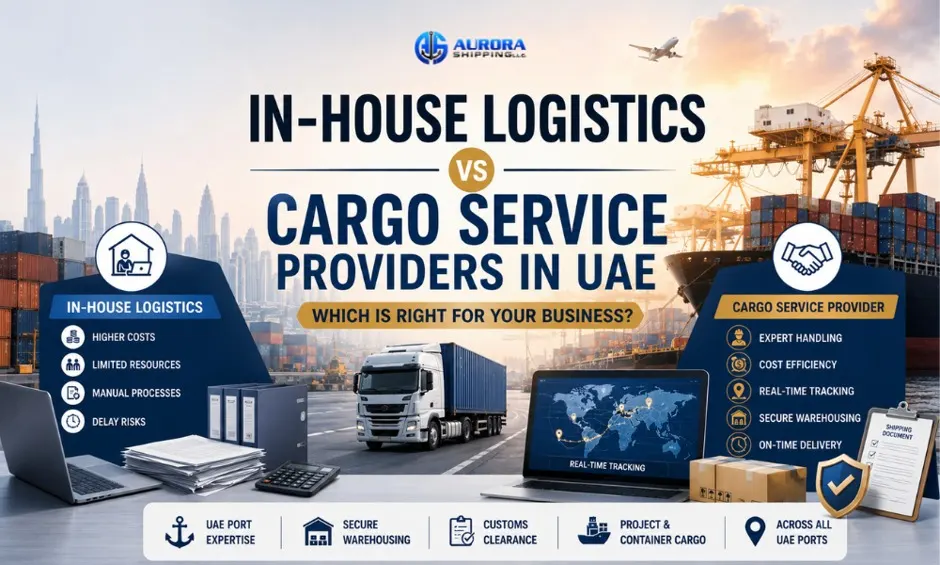
In-House Logistics vs Cargo Service Providers in UAE
In-House Logistics vs Cargo Service Providers in UAE
There’s a moment every growing business hits, usually right after a shipment goes sideways at customs, or a container sits at Jebel Ali longer than it should have. That’s when the question comes up: should we be handling this ourselves, or is it time to bring in someone who does this for a living?
It’s not a small decision. Getting it wrong either way costs money, time, or both. Some businesses stick with in-house logistics for years without issue, right up until volume grows or a shipment becomes more complicated than usual. Others bring in a provider too early, before it actually makes financial sense, and end up paying for infrastructure they didn’t really need yet. The right call depends less on company size and more on how complex, frequent, and unpredictable the shipments actually are.
What “In-House Logistics” Actually Means in Practice
Running logistics in-house sounds straightforward on paper. Hire a coordinator, build some relationships with customs brokers, handle your own tracking. In reality, it means someone on your team is now responsible for staying current on port procedures, customs documentation, warehousing options, and carrier relationships, on top of whatever their actual job was supposed to be.
For companies moving a handful of shipments a year, that can work fine. The problem shows up as volume grows, or when cargo gets more complex, particularly with project cargo, oversized loads, or anything that needs coordination across multiple UAE ports rather than a single predictable route.
The Real Value a Cargo Service Provider Delivers
A dedicated provider isn’t just outsourcing the same work; it’s usually a different level of infrastructure entirely. Comprehensive port agency services include coordinating port calls, managing customs clearance, and supporting crew requirements across UAE ports, eliminating the need for businesses to maintain dedicated in-house teams and local port connections.
The quality of cargo services is often reflected in several important operational areas:
- Stevedoring: vetted, experienced handling crews rather than whoever’s available that day.
- Warehousing: secure storage that’s actually built for cargo, not a spare corner of a facility.
- Tracking: transparent visibility into where a shipment actually is, instead of a string of phone calls to figure it out.
- Cargo clearance: documentation and customs formalities handled as a dedicated service, not an afterthought tacked onto general freight support.
Providers built around this kind of setup, backed by real port experience rather than a generic logistics playbook, tend to exist specifically because doing all of this well, in-house, at scale, is genuinely hard. Aurora Shipping, for example, brings more than 15 years of maritime experience across the Gulf to exactly this kind of coordination, supporting both containerized and project shipments across Dubai, Jebel Ali, and Abu Dhabi.
The Market Is Already Answering This Question
This isn’t just a theoretical debate. Across the UAE logistics market, buyers are increasingly combining warehousing, customs brokerage, and freight forwarding under single contracts rather than sourcing each separately. That shift didn’t happen because bundling sounds nice; it happened because fragmented vendor relationships were costing shippers time and money, and consolidating under one provider turned out to be faster and more predictable.
Free zones like JAFZA are reinforcing this too, offering bonded, duty-deferred storage with value-added processing built in, the kind of infrastructure that’s difficult to justify building in-house unless cargo volume is genuinely massive.
When In-House Actually Makes Sense
To be fair, in-house logistics isn’t automatically the wrong call. It tends to work well when:
- Shipment volume is low and predictable, on the same route, month after month.
- The business has already established reliable partnerships with preferred shipping lines or port authorities.
- Cargo is simple, standard containerized goods, with no oversized or project cargo involved.
- There’s genuinely enough internal bandwidth to treat logistics as a real function, not a side task.
As shipping activities become more complex, involving multiple UAE ports or specialised cargo, partnering with an experienced cargo service provider becomes increasingly important for maintaining efficient operations.
In-House vs Cargo Service Provider: A Quick Comparison
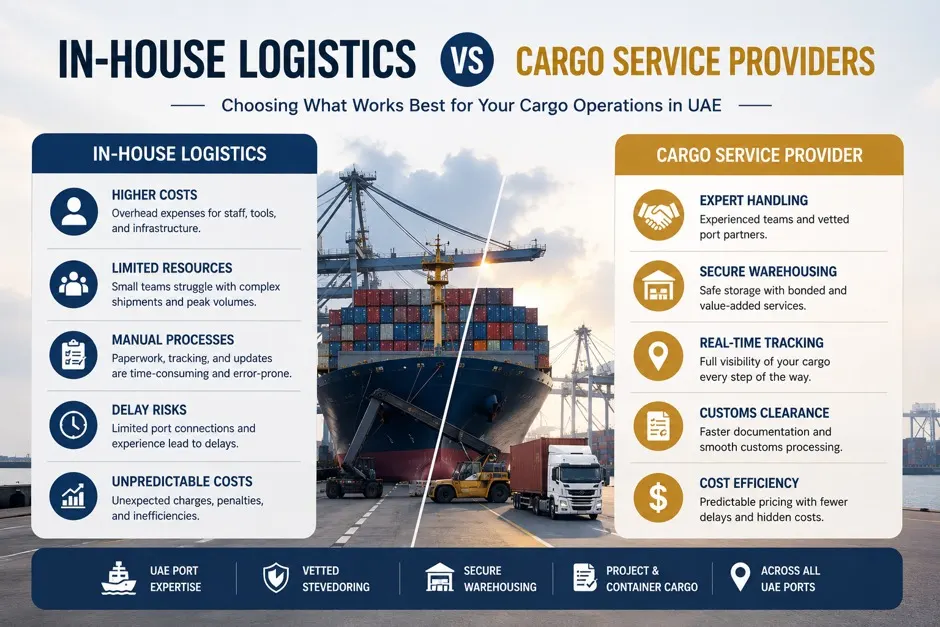
Compare in-house logistics and cargo service providers to choose the best logistics solution for your UAE business. Frequently Asked Questions
Is in-house logistics cheaper than hiring a cargo service provider?
Not always. It can look cheaper on paper, but delays, customs errors, and inconsistent tracking often add hidden costs that outweigh the savings over time.
When should a business switch from in-house to a dedicated provider?
Usually once shipment volume grows, cargo becomes more complex with project or oversized loads, or operations expand across more than one UAE port.
Does a cargo service provider replace an internal logistics team entirely?
Not necessarily. Many businesses keep a small internal point of contact while outsourcing the operational heavy lifting, including port coordination, stevedoring, warehousing, and tracking.
What’s the biggest risk of managing logistics in-house at scale?
Inconsistent execution. Without dedicated port relationships and infrastructure, delays and miscommunication tend to increase as volume grows.
Can cargo service providers manage both containerized shipments and project cargo?
A full service provider typically does, covering standard containerized shipments as well as more complex project cargo requiring specialized handling.
Choosing What Works for Your Cargo Volume
There’s no universal right answer here; it genuinely depends on volume, complexity, and how many ports a business is actually moving cargo through. But the pattern across the UAE market is fairly clear: as shipments scale up, bundled, provider-led logistics tends to outperform in-house setups on speed, predictability, and cost control.
With over 15 years of maritime experience across the Gulf, Aurora Shipping provides reliable support for containerized and project cargo throughout UAE ports. Our services include trusted stevedoring, secure warehousing, and transparent shipment tracking, helping businesses manage complex logistics with confidence and efficiency.
-
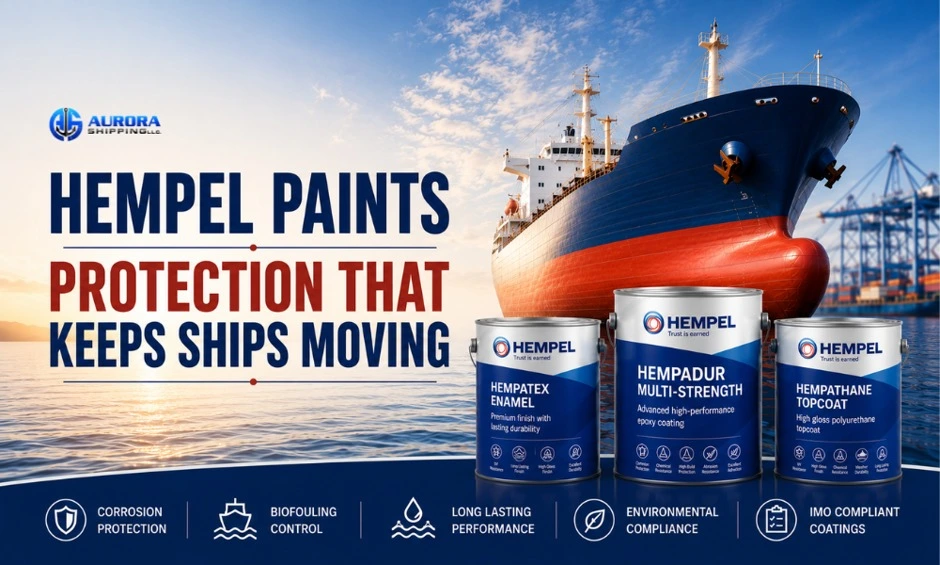
What Are Hempel Paints Used For on Ships?
What Are Hempel Paints Used For on Ships?
Hempel Paints are a range of marine coatings designed to shield a vessel’s hull, tanks, and steel structure from rust, marine growth, and everyday wear during years spent at sea. The company traces its roots back to Denmark in 1915, when it started life as Hempel’s Marine Paints Ltd., and it has spent more than a hundred years refining coating systems for both new vessel construction and routine dry-dock maintenance. In the UAE, Aurora Shipping LLC serves as an authorized Hempel distributor, providing ship owners in Dubai, Jebel Ali, and Abu Dhabi with direct access to genuine products and hands-on technical support.
Which Parts of a Ship Are Coated With Hempel Paint?
A vessel gets Hempel coatings in three main areas: the submerged hull, the topsides and superstructure, and the internal tanks and ballast spaces. Since each of these zones deals with its own set of stresses, Hempel has developed a dedicated product line built specifically for it.
- Underwater hull: Antifouling ranges such as Hempel’s Olympic line stop barnacles, algae, and other marine organisms from taking hold on the hull.
- Topsides and superstructure: Finish coats such as Hempatex Enamel shield exposed steel from sun exposure, salt spray, and everyday abrasion.
- Tanks, ballast spaces, and structural steel: Thick-film epoxy primers such as Hempadur protect against internal rust in tight, often damp compartments.
Getting the right product onto the right surface is a central piece of ship-supply and dry-dock planning, so owners don’t have to guess which coating belongs where.
Why Do Vessels Need Marine Coatings in the First Place?
Ships require specialized coatings because bare steel corrodes quickly in salt water, and an uncoated hull accumulates marine growth that increases drag and raises fuel consumption. Ignore either issue and a vessel’s working life shortens while upkeep costs climb.
There’s a direct connection between biofouling and fuel burn: a fouled hull creates more hydrodynamic resistance, forcing the engine to work harder just to hold speed. That’s why coating performance gets treated as a running cost, not simply a matter of appearance, and it’s also why the industry has been shifting toward foul-release coatings aimed squarely at cutting fuel use and emissions.
Regulation adds further pressure. Analysts now describe the marine coatings market as entering a “dual compliance phase,” in which owners have to hit emissions targets and satisfy tougher environmental rules at the same time, turning coating selection into a compliance decision as much as a maintenance one.
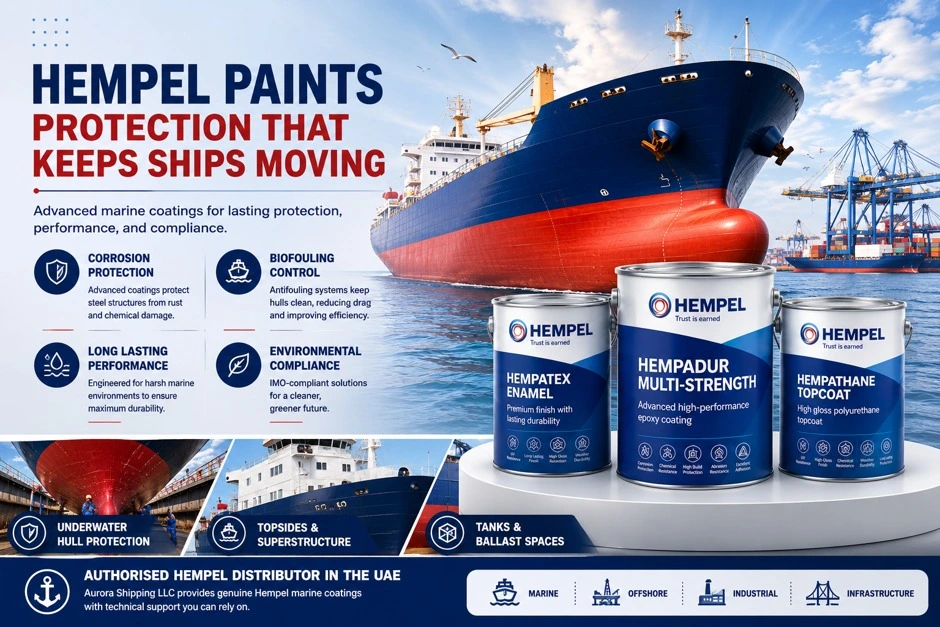
Hempel Marine Paints for reliable ship protection and marine coatings. How Does Hempel Paint Differ From Ordinary Paint?
Hempel Paint is built for permanent submersion, harsh UV exposure, and resistance to biological growth, none of which standard household or architectural paint is designed to handle. Wall paint just needs to dry and cure once; marine coatings have to keep performing for years under constant chemical and physical stress.
The Olympic antifouling range is a good example. It relies on self-polishing, ion-exchange-based technology that forms a hydrolysable active layer, continuously refreshing the antifouling surface as the vessel moves through the water. A number of these formulations are also tin-free and meet the standards of the IMO’s International Convention on the Control of Harmful Anti-Fouling Systems on Ships, adopted in October 2001, a requirement ordinary paint was never built to satisfy.
Hempel has also been pushing into newer chemistry. Its Hempaguard fouling-release technology itself isn’t new, but in mid-2025 Hempel introduced Hempaguard NB, a silicone-based hull coating built specifically for newbuild vessels, optimized for application during construction without requiring an extra dry-dock, and aimed at owners who want reduced drag without depending on biocide release
Hempel Product Lines Compared: Which Coating Does What?
Picking between Hempel’s product families becomes much simpler once you know what each one is meant to do. The table below breaks down three of the core lines used across fleets in the UAE.
Product Line Primary Use Key Characteristic Best Suited For Hempadur Multi-Strength Primer / anti-corrosive base coat Advanced high-performance epoxy coating with high-build protection for steel and tanks Ballast tanks, structural steel, newbuild priming Hempatex Enamel Topcoat / finish coat Premium enamel finish with lasting durability against UV and abrasion Topsides, superstructure, and deck areas Hempathane Topcoat Finish coat High-gloss polyurethane topcoat for a premium, long-lasting appearance Superstructure, deckhouses, and areas needing high-gloss aesthetic finish Where Can Ship Owners in the UAE Source Hempel Paints?
Owners and operators based in the UAE can source Hempel Paints through an authorized distributor located in Dubai Maritime City. Buying through an authorized channel matters because it ensures the product is genuine, batches are handled correctly, and buyers get access to Hempel’s technical data sheets for each formulation.
That includes:
- Certified marine coatings, antifouling products, and their supporting technical documentation
- On-site technical guidance for matching coatings to vessel type and trading pattern
- Coordination with dry-dock schedules as part of broader shipping agency and marine services support across Jebel Ali, Port Rashid, and Abu Dhabi
This kind of local access is especially useful for owners who also need IHM and Green Passport documentation, since the coatings used on a vessel are one of the data points tracked under hazardous material inventories.
Frequently Asked Questions
Is Hempel Paint only used on large commercial ships?
No. Hempel makes coating systems for commercial vessels, yachts, offshore structures, and industrial assets, with formulations tailored to each use case.
How often does a ship need to be repainted with Hempel Paints?
It varies by coating system and trading pattern, but antifouling is typically renewed at each dry-docking, generally every 24 to 60 months depending on the product chosen.
Does Hempel Paint help with fuel efficiency?
Yes. A hull kept clear of fouling stays smoother, which means less drag and less fuel burned to hold speed — one of the main reasons demand for foul-release and self-polishing antifouling systems keeps growing.
Who is an authorized Hempel distributor in the UAE?
Aurora Shipping LLC is an authorized distributor of Hempel Paints in the UAE, supplying certified coatings along with full technical support.
What’s the difference between antifouling and anti-corrosive coatings?
Antifouling coatings stop marine organisms from attaching to the hull, while anti-corrosive coatings like Hempadur protect the underlying steel from rust and chemical breakdown, typically sitting beneath the antifouling layer.
Can Hempel coatings support IMO compliance?
Yes. Several Hempel antifouling products are formulated to meet the IMO’s Anti-Fouling Systems Convention, and coating selection is also tracked as part of IHM documentation.
Protect Your Vessel with the Right Hempel Coating Partner
Choosing the right Hempel Paint is about more than picking a product off a shelf; it’s about protecting the asset your operation depends on. From hull antifouling to internal tank coatings, every layer plays a part in how long a vessel stays seaworthy, efficient, and compliant.
Choosing the right supplier is what makes that possible. As an authorized Hempel distributor based in Dubai Maritime City, Aurora Shipping LLC helps you select the right system for your vessel, fits it around your dry-dock schedule, and backs it with the same team already managing your port calls, cargo, and compliance paperwork.
If you’re planning a dry-dock, a newbuild, or just want expert advice on your next coating cycle, reach out to Aurora Shipping LLC — our team is available 24/7 to help you protect what keeps you moving.
- Underwater hull: Antifouling ranges such as Hempel’s Olympic line stop barnacles, algae, and other marine organisms from taking hold on the hull.
-
UAE's New Maritime Law and Your Shipping Agency
UAE’s New Maritime Law and Your Shipping Agency
For more than four decades, the UAE’s maritime sector operated under a single piece of legislation — Federal Law No. 26 of 1981. It served its purpose for a long time. But shipping in 2024 looks nothing like shipping in 1981, and the old law was starting to show its age in ways that genuinely affected how vessels were registered, how disputes were resolved, and who could actually operate under the UAE flag.
That changed with Federal Decree-Law No. 43 of 2023, which came into effect on 29 March 2024. It is the most significant overhaul of UAE maritime regulation in over forty years — and if you own, charter, or operate a vessel in UAE waters, it touches almost every part of how your shipping agency does business on your behalf.
This guide breaks down what actually changed, why it matters, and what it means in practice for shipowners working with a shipping agency in the UAE today.
Why This Law Took So Long to Update
The 1981 law was written for a maritime industry that barely resembles the one operating in the Gulf today. Vessel ownership structures have become more international. Charter arrangements have become more complex. And the UAE’s ambitions as a global shipping hub required a legal framework capable of competing with established maritime jurisdictions worldwide.
The old law restricted UAE flag registration almost entirely to vessels owned by UAE nationals or companies where UAE nationals held a majority shareholding. That worked when the UAE’s maritime sector was smaller and less internationally integrated. It became a genuine obstacle as the country positioned itself as a serious player in global shipping, logistics, and offshore energy.
The new Maritime Law addresses this directly — and the changes go well beyond a simple legal refresh.
What Actually Changed — The Parts That Matter
Who Can Register a Vessel Under the UAE Flag
This is the headline change, and it is a big one.
Under the old law, registering a vessel under the UAE flag required a majority of UAE national ownership. Under the new law, that requirement has been significantly widened. A vessel can now be registered if the majority of its shares are owned by individuals or companies holding UAE nationality, GCC nationality, or by entities with a domicile, head office, or ship management office based in the UAE.
In practical terms, this means UAE residents of any nationality can now own and register vessels in the UAE, and so can companies incorporated here or vessels managed by UAE-based entities. That is a substantial shift from a law that, for over forty years, kept ownership tightly restricted.
For shipowners considering UAE registration — or for international operators thinking about establishing a UAE-based presence — this single change opens a door that was largely closed before.
A New Ship Register and a New Authority
Vessel registration now sits with a dedicated “Ship Register” under the Ministry of Energy and Infrastructure, replacing the old Maritime Inspection Department that previously handled registration under the Ministry of Transportation.
This is more than an administrative reshuffle. A dedicated register, supported by digital platforms for registration, is designed to streamline a process that was historically slow, paperwork-heavy, and spread across multiple regulatory touchpoints. For shipowners, this should translate into faster registration timelines and fewer bureaucratic delays — though the practical experience will depend on how smoothly the new system rolls out.
Under-Construction and Chartered Vessels Can Now Be Registered
Previously, registering a vessel still under construction was barely addressed in UAE law. The new Maritime Law introduces a dedicated “Under-Construction Ships Register,” with the shipbuilder — rather than the buyer — responsible for recording the shipbuilding contract.
Chartered vessels also gained new registration rights. Charterers of foreign-registered vessels can now apply to register under the UAE flag, provided the charter party meets a minimum duration and the registration requirements are satisfied. This is particularly relevant for operators running long-term charters in UAE waters who previously had no straightforward path to UAE registration.
Vessel Arrest Procedures Have Been Modernised
The new law also overhauls how vessel arrests work in the UAE — a topic that matters enormously to anyone navigating maritime disputes or commercial disagreements involving a vessel.
The list of debts that qualify as a “maritime debt” — the legal basis for a precautionary arrest — has been expanded. The law also introduces the concept of sister ship arrest, aligning UAE practice more closely with international convention standards. At the same time, new procedural protections have been added: anyone seeking to arrest a vessel must now provide financial security covering crew and vessel maintenance costs during the arrest period, and the arrest of chartered ships is now restricted to the validity period of the charter agreement.
For shipowners, this cuts both ways. Arrest procedures are now more aligned with international norms, which generally means more predictability. But the expanded list of qualifying debts also means there are more circumstances under which a vessel could face arrest than there were under the old law.
Faster Court Procedures
Court timelines have also been compressed. Under the old law, a hearing following an arrest application needed to be scheduled within 30 days. Under the new law, that window has been cut to 15 days. For shipowners and operators, faster court procedures generally mean disputes get resolved — and vessels potentially released — more quickly than under the previous framework.
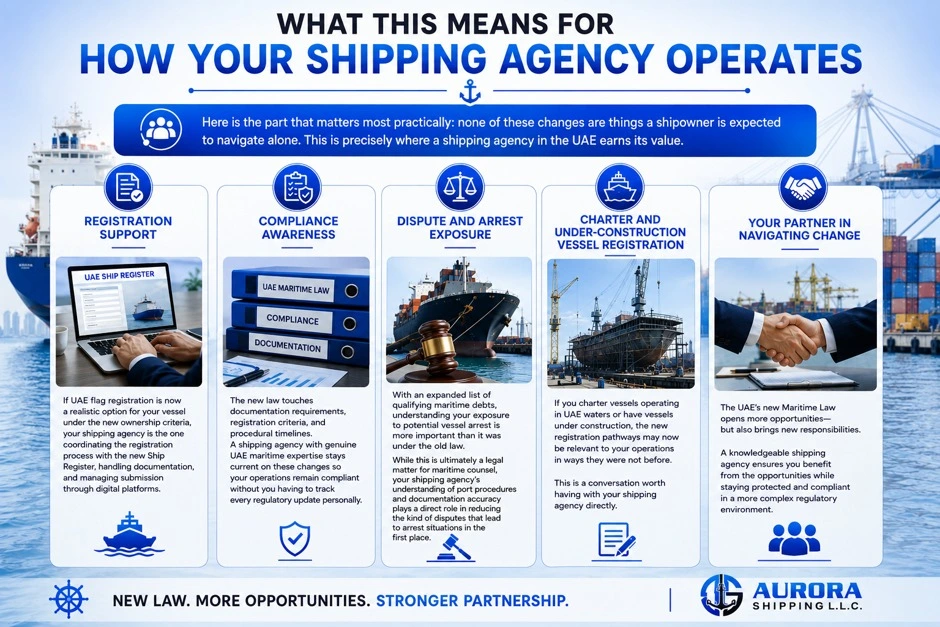
How UAE Maritime Law 2026 impacts shipping agencies and vessel registration. What This Means for How Your Shipping Agency Operates
Here is the part that matters most practically: none of these changes are things a shipowner is expected to navigate alone. This is precisely where a shipping agency in the UAE earns its value.
Registration support:
If UAE flag registration is now a realistic option for your vessel under the new ownership criteria, your shipping agency is the one coordinating the registration process with the new Ship Register, handling documentation, and managing submission through whatever digital platforms the Ministry rolls out.Compliance awareness:
The new law touches documentation requirements, registration criteria, and procedural timelines. A shipping agency with genuine UAE maritime expertise stays current on these changes so your operations remain compliant without you having to track every regulatory update personally.Dispute and arrest exposure:
With an expanded list of qualifying maritime debts, understanding your exposure to potential vessel arrest is more important than it was under the old law. While this is ultimately a legal matter for maritime counsel, your shipping agency’s understanding of port procedures and documentation accuracy plays a direct role in reducing the kind of disputes that lead to arrest situations in the first place.Charter and under-construction vessel registration:
If you charter vessels operating in UAE waters or have vessels under construction, the new registration pathways may now be relevant to your operations in ways they were not before. This is a conversation worth having with your shipping agency directly.
Why This Matters Beyond the Legal Detail
Strip away the legal specifics, and the bigger picture is this: the UAE is positioning itself as a serious, internationally competitive maritime jurisdiction. Wider registration eligibility, a modernised dispute resolution framework, and alignment with international arrest conventions are not isolated changes — they are part of a coordinated effort to make the UAE more attractive to global shipowners, charterers, and maritime investors.
That has knock-on effects across the entire sector. More vessels registering under the UAE flag mean more port activity. More international operators establishing UAE-based management structures mean more demand for local expertise — shipping agencies, crew manning, marine surveys, P&I support, and everything in between.
For shipowners already operating in the UAE, or considering it, this is a genuinely good moment to revisit how your operations are structured and whether the new regulatory environment opens up options that were not available to you before.
Frequently Asked Questions
When did the new UAE Maritime Law come into effect?
Federal Decree-Law No. 43 of 2023 came into effect on 29 March 2024, replacing the previous maritime law that had been in place since 1981.
Can foreigners now register a vessel under the UAE flag?
Yes, in a wider range of circumstances than before. Vessels can be registered if the majority of shares are owned by UAE or GCC nationals, or by entities with a domicile, head office, or ship management office in the UAE.
What is the new Ship Register?
It is a dedicated vessel registration authority under the Ministry of Energy and Infrastructure, replacing the previous Maritime Inspection Department and introducing digital registration platforms.
Can chartered vessels be registered under the UAE flag now?
Yes. Charterers of foreign-registered vessels can apply for UAE registration provided the charter party meets the minimum required duration and other registration conditions are satisfied.
How has the vessel arrest procedure changed under the new law?
The list of qualifying maritime debts has expanded, sister ship arrest is now recognised, and applicants seeking an arrest must provide financial security for crew and vessel maintenance costs during the arrest period.
Does a shipping agency help with vessel registration under the new law?
Yes. A shipping agency with UAE maritime experience coordinates registration documentation, liaises with the relevant authorities, and helps shipowners understand whether their vessel now qualifies for UAE registration under the expanded criteria.
Conclusion
Laws like this do not change overnight, and their real impact tends to show up gradually — in registration numbers, in how disputes get resolved, and in how many international operators decide the UAE is worth establishing a presence in. But the direction is clear. The UAE has built a more modern, more internationally aligned maritime legal framework, and that creates a genuine opportunity for shipowners who understand how to use it.
Navigating that shift, registration eligibility, documentation, port compliance, and day-to-day operational support is exactly what a shipping agency in the UAE is there for. The law has changed. The need for experienced, on-the-ground support to make sense of it has not.
Whether your focus is vessel registration, regulatory compliance, or protecting your fleet with trusted marine coatings and maintenance solutions, Aurora Shipping LLC brings everything together under one roof. By combining ship agency, marine services, and Hempel coatings, we provide a seamless, integrated solution without the complexity of managing multiple service providers.
If you are reassessing your vessel’s registration options, chartering structure, or general compliance position under the new Maritime Law, the team at Aurora Shipping LLC is available to talk through what it means for your specific operations.
-

Why Yacht Services in Dubai Are in High Demand in 2026
Why Yacht Services in Dubai Are in High Demand in 2026
Yacht services in Dubai are in high demand in 2026 because the emirate’s marina infrastructure, regulatory efficiency, and growing superyacht traffic have made it one of the fastest-growing yachting hubs outside the Mediterranean. Dubai now hosts 17 marinas with more than 3,000 berths, supporting everything from mid-size cruisers to gigayachts. For owners, charter guests, and VIP clients alike, that growth means more competition for berths and a real need for coordinated support — from arrival clearance to 24-hour concierge service.
Why Is Yacht Demand in Dubai Increasing Right Now?
Demand is rising because Dubai has positioned itself as a year-round yachting destination with world-class infrastructure and simplified access procedures. The Middle East and Africa (MEA) yacht industry is growing at a compound annual growth rate of around 8% between 2026 and 2035, driven by rising luxury tourism and expanding ultra-high-net-worth populations.
Dubai leads the regional growth. The UAE yacht industry is valued at approximately USD 136 million in 2026, with projections reaching USD 174.9 million by 2033. That expansion isn’t just about new yacht sales — it directly increases demand for supporting services, since more vessels operating in UAE waters mean more owners and charter guests who need reliable local agency support around the clock.
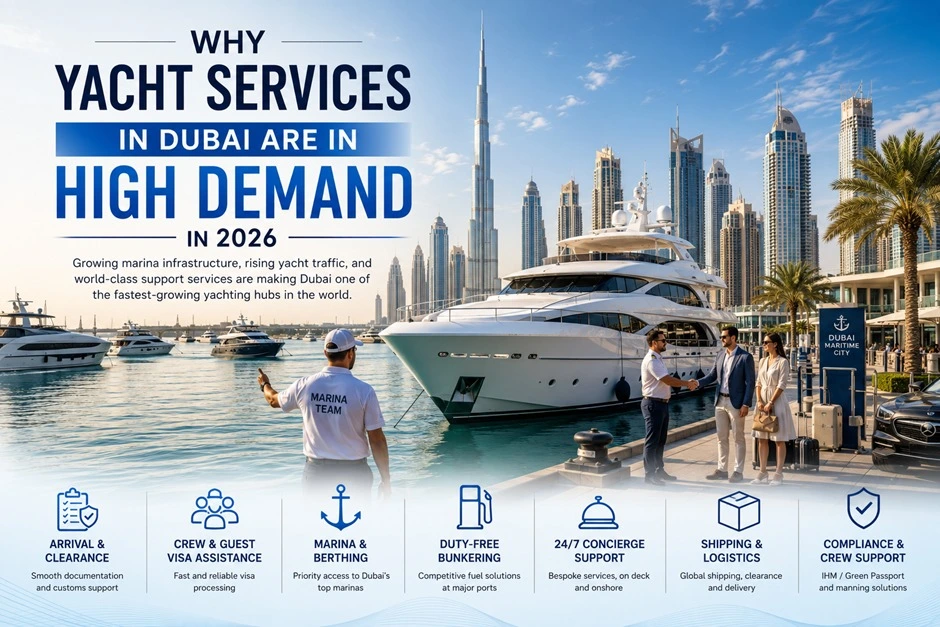
Professional yacht services in Dubai support luxury vessels with berthing, customs, bunkering, logistics, and crew assistance. What Yacht Services Do Owners Actually Need in Dubai?
Most first-time owners assume “yacht services” start and end with docking and fuel. In practice, it covers a lot more ground, and once a yacht is actually moving through UAE waters, the gaps in a half-service setup show up fast. A complete yacht agency typically handles:
- Arrival and clearance formalities: The customs paperwork and documentation that must be completed before a yacht can legally enter or leave UAE waters. Get this wrong, and a vessel can sit waiting at port instead of getting straight to the marina.
- Visa assistance for crew and guests: Crew rarely all hold the same passport, and visa processing timelines vary. Sorting this in advance means nobody’s stuck onshore when the yacht is ready to sail.
- Duty-free bunkering and refuelling: At major UAE ports and marinas, coordinated around the yacht’s actual schedule rather than whenever a supplier happens to be free.
- Marina and berthing arrangements: increasingly competitive during peak season (October through April), when demand for space at Dubai’s busier marinas can outpace availability if not booked early.
- Shipping and freight forwarding: including the clearance, collection, and delivery of spare parts, provisions, or personal shipments arriving from overseas — a detail owners often overlook until something urgent needs to reach the yacht quickly.
- 24-hour concierge service and support: covering everything from private transfers and restaurant reservations to last-minute, bespoke lifestyle requests that come up mid-charter.
- Crew manning and IHM/Green Passport compliance: keeping the vessel aligned with environmental and regulatory standards without the owner having to track requirements themselves.
None of these run well in isolation. A provider handling clearance while a separate contact deals with bunkering and another manages concierge tends to create exactly the kind of delay owners are trying to avoid. Full-service yacht agencies bundle all of it under one roof, so there’s a single point of contact managing the whole picture — not five vendors who’ve never spoken to each other.
How Does Dubai Compare to Other Yachting Hubs?
Dubai competes directly with the Mediterranean and Southeast Asia as a winter cruising destination, but its infrastructure investment sets it apart regionally. Europe still holds the largest share of global charter revenue, with Mediterranean hotspots dominating summer bookings. Dubai, however, has become a preferred alternative during the October–April season, when Mediterranean activity slows down.
This seasonal complementarity, rather than direct competition, is part of why Dubai’s yacht traffic keeps climbing. Owners increasingly split their year between the two regions instead of choosing one exclusively.
What’s Driving Marina and Infrastructure Growth in Dubai?
Infrastructure growth is being driven by sustained investment in marina capacity and superyacht-specific facilities. Dubai’s marina count has grown from 15 to 17 in the past year alone, with berth capacity expanding to accommodate gigayachts as well as mid-size vessels.
At least seven major marina projects are currently underway across the Emirates, signaling that this growth isn’t slowing down. The Dubai International Boat Show, running November 25–29, 2026, further reinforces the city’s role as a regional marketplace for brokerage deals, charter planning, and service providers.
How Do I Choose a Reliable Yacht Service Provider in Dubai?
Choosing a reliable provider comes down to three things: regional experience, a full-service offering, and genuine discretion for VIP and high-net-worth clients. For government officials, VIP guests, and private owners alike, the right provider should combine operational reliability with a bespoke, hospitality-driven approach — not just paperwork handled efficiently, but comfort and convenience delivered consistently, on deck and onshore.
Providers headquartered in Dubai Maritime City with a strong regional network, such as Aurora Shipping, are generally better positioned to manage a yacht’s full lifecycle — from arrival through departure —backed by 24/7 support and one dedicated point of contact from start to finish.
Yacht Support Options in Dubai: A Comparison
Factor Full-Service Yacht Agency In-House Crew Only Freelance/ Piecemeal Providers Clearance & customs formalities Included and coordinated Owner/crew must arrange separately Varies by provider Marina & berthing arrangements Established relationships, faster access Dependent on the crew’s local contacts Inconsistent Duty-free bunkering Coordinated directly The owner must source independently Varies by provider Concierge & VIP lifestyle support 24-hour, included Not typically offered Rarely offered Crew visa & manning support Included Managed internally Rarely covered Best suited for Owners and VIP guests wanting one point of contact Owners with experienced local crew Short, occasional visits Frequently Asked Questions
What Is Driving the Growing Demand for Yacht Services in Dubai in 2026?
Growing marina infrastructure, rising UHNW populations in the region, and Dubai’s positioning as a winter alternative to the Mediterranean are driving increased yacht traffic and, in turn, demand for full-service agency support.
How many marinas will Dubai have for yachts in 2026?
Dubai hosts 17 marinas with more than 3,000 berths as of 2026, up from 15 the previous year.
Does yacht agency support in Dubai include concierge services?
Yes. A full-service provider typically includes 24-hour concierge support alongside clearance, marina coordination, and crew handling, covering everything from private transfers to bespoke lifestyle requests.
What is the busiest season for yachts in Dubai?
Dubai’s peak yachting season runs from October to April, aligning with cooler weather and the period when Mediterranean charter activity typically slows.
How does Dubai’s yacht market compare to the Mediterranean?
Europe still leads in overall charter revenue, but Dubai has grown into a strong seasonal complement rather than a direct competitor, attracting owners during the Mediterranean’s off-season.
What should I look for in a yacht service provider in Dubai?
Look for a provider offering full-service yacht agency and lifestyle support, clearance, bunkering, marina coordination, crew handling, and 24-hour concierge, rather than piecing together separate vendors for each function.
Choosing the Right Partner for the Journey Ahead
Dubai’s yacht sector isn’t growing by accident — it’s the result of sustained marina investment, a widening base of owners and VIP guests choosing the region, and providers raising the bar on what full-service support actually looks like. For owners and charter guests navigating that growth, working with a provider who can combine operational reliability with genuine hospitality makes the difference between a smooth season and a frustrating one.
If you’re planning a yacht’s arrival, departure, or extended stay in UAE waters, Aurora Shipping delivers full-service yacht agency and concierge support, headquartered in Dubai Maritime City with a network across the region.
-
How a Protecting Agency Keeps Your Cargo Safe in the UAE
How a Protecting Agency Keeps Your Cargo Safe in the UAE
Most vessel owners don’t think about independent port supervision until something goes wrong. A demurrage claim that doesn’t add up. A disbursement account with charges nobody can explain. A Statement of Facts that doesn’t reflect what actually happened on board. By the time these issues surface, the vessel has already sailed, and the evidence is difficult to challenge.
This is the core problem that protecting agency services in the UAE exists to solve — and it’s a problem that affects more port calls than most owners realise.
If you operate vessels calling at UAE ports regularly, understanding how a protection agency in the UAE works could save you significant time, money, and operational headaches.
The Real Role of a Protecting Agency in Shipping
Here’s something worth understanding clearly. A protecting agent is not a general port agent. They don’t handle berth bookings, crew formalities, or routine port logistics. That’s the job of the port agent, typically the one nominated by the charterer.
A protecting agent does something different. They work exclusively on behalf of the principal, the vessel owner or operator, to supervise what the other side’s agent is doing. They attend cargo operations independently. They review documentation as it’s being created, not after the fact. They check port disbursement accounts line by line against applicable tariffs and flag anything that doesn’t match.
In short, they make sure nobody takes advantage of an absent owner.
This matters especially in situations where the charterer has appointed a local agent and the owner has no independent representative at the port. Without someone physically present on your behalf, you’re relying on another party’s team to report fairly on matters that directly affect your costs and your cargo. That’s a significant risk, and one that’s entirely avoidable.
Why UAE Ports Make Independent Supervision Even More Important
The UAE handles thousands of vessel calls every year. Jebel Ali is one of the highest-throughput ports in the world. Khalifa Port continues to expand its capacity. Dubai Maritime City has developed into a central hub for maritime operations across the wider region.
All of this is good news for trade. But the sheer volume of activity also means port operations move extremely fast. Documentation gets processed quickly. Disbursement accounts get compiled under time pressure. Cargo figures get recorded by handlers who are managing multiple vessels simultaneously.
In that environment, small errors are common. Some are genuine mistakes. Others are not. Either way, without a protecting agent present, they often go unnoticed until long after the vessel has departed — at which point disputing them becomes significantly harder.
A protecting agent catches these things in real time. That’s the difference.

Protecting agency ensuring secure vessel operations, cargo monitoring, and port supervision. What Protecting Agency Services in the UAE Actually Cover
Port Disbursement Verification
This is one of the most practically valuable parts of protecting agency work. Pro forma disbursement accounts sometimes include charges that don’t align with published port tariffs, port dues calculated at the wrong rate, pilotage fees applied incorrectly, or additional services billed without clear justification.
A protecting agent reviews every line of these accounts carefully. Where charges don’t match the applicable tariff, they push back. For vessel owners calling regularly at UAE ports, this oversight alone can recover costs that would otherwise go unquestioned.
Statement of Facts and Laytime Documentation
The Statement of Facts is the document that determines laytime calculations, demurrage liability, and a range of other commercial outcomes. When it comes to protecting your cargo, getting it right isn’t a choice; it’s a necessity.
A protecting agent doesn’t wait until the end of the port call to review this document. They monitor operations as they happen and ensure that the record accurately reflects what occurred on board. When delays happen, they confirm the reasons are correctly documented. When operations run smoothly, they make sure that it’s recorded accurately too.
Cargo and Vessel Monitoring
Whether it’s a bulk carrier discharging cargo or a tanker completing loading operations, independent cargo supervision provides an accurate record of what happened and when. Quantity discrepancies, damaged goods, or irregular handling procedures that go unwitnessed are extremely difficult to dispute afterward. An agent on the ground changes that situation entirely.
Operational Coordination and Reporting
Beyond direct supervision, protecting agents coordinate with marine surveyors, port authorities, and service providers as needed. Regular vessel activity reports keep principals informed throughout the port call, not just at the end of it. Businesses requiring broader port support can integrate protecting agency services with shipping agency expertise to ensure seamless end-to-end operational management.
Vessel Types That Benefit from Protecting Agency Support
Independent port supervision is relevant across a wide range of vessel categories. Each type presents its own documentation challenges, cargo handling considerations, and port cost variables.
Bulk carriers face particular risks around cargo quantity verification and laytime disputes. Tankers require careful monitoring of loading and discharge operations and accurate timing records. Container vessels, offshore support vessels, general cargo ships, and project cargo vessels all have their own operational characteristics that a protecting agent needs to understand and supervise accordingly.
The common thread across all of them is this — when port operations aren’t independently monitored, discrepancies tend to appear. And they tend to cost the owner money.
What Happens Without Independent Supervision
It’s worth being direct about this. Owners who skip protecting agency support aren’t just taking a small risk; they’re operating without any independent check on what’s being reported, charged, and documented on their behalf at port.
A single unchallenged demurrage claim can cost far more than a protecting agent’s fees for an entire year of port calls. One inflated disbursement account, left unreviewed, sets a precedent that gets repeated on the next call and the one after that. Documentation errors that aren’t corrected during the port call become almost impossible to dispute six months later when a legal claim surfaces.
This isn’t about distrust. It’s simply about having accurate, independently verified records, the same standard any well-run maritime operation should maintain.
For businesses that also require cargo service support or marine surveys during UAE port calls, combining these with protecting agency coverage provides a much more complete picture of what’s happening on the ground.
Choosing the Right Protecting Agency Partner in the UAE
Local presence matters more than most owners initially appreciate. A protecting agent who knows the specific operational procedures at Jebel Ali or Khalifa Port works very differently from one coordinating remotely. Response time during active cargo operations can mean the difference between catching a discrepancy and missing it permanently.
Documentation experience is equally important. Reviewing a Statement of Facts or a disbursement account isn’t administrative work — it requires genuine maritime knowledge and a clear understanding of what standard practice looks like versus what needs to be questioned.
Availability is another factor that often gets underestimated. Port calls don’t follow business hours. A protecting agent who is reachable and responsive at any hour provides a fundamentally different level of service than one who checks in once a day.
Finally, consider the wider service offering. Agencies that also provide ship supply services, IHM and Green Passport support, or shipping agency coordination can deliver more connected and efficient coverage across every aspect of a UAE port call.
Frequently Asked Questions
A protecting agency independently supervises vessel port operations on behalf of vessel owners or charterers, ensuring their interests are protected when a local agent has been appointed by the other party.
A port agent manages the general logistics of a vessel’s port call. A protecting agent works independently to supervise those operations specifically on behalf of one party, identifying and flagging any discrepancies.
It means reviewing every charge on a disbursement account against published port tariffs and actual vessel activities to confirm that costs are accurate, justified, and compliant with applicable rates.
Bulk carriers, tankers, container vessels, offshore support vessels, general cargo ships, and project cargo vessels all regularly use protecting agency support during UAE port calls.
Yes. Protecting agency support integrates effectively with shipping agency, cargo service, marine survey, and ship supply services for comprehensive port call coverage.
Final Thoughts: Choosing the Right Protecting Agency in the UAE
Navigating UAE port operations without independent supervision leaves vessel owners exposed to risks they may not even be aware of, from inflated port costs to unverified documentation that surfaces problems weeks or months later. A protecting agency closes that gap, providing the oversight needed to keep operations transparent, costs accurate, and disputes to a minimum.
Whether you operate a single vessel calling occasionally at UAE ports or manage a diverse fleet with regular port calls across Jebel Ali, Khalifa Port, and Dubai Maritime City, having a trusted protecting agent on the ground makes a measurable difference to how smoothly each port call unfolds.
Protecting your cargo and vessel interests during a UAE port call starts with having the right people on the ground. Independent supervision, accurate documentation, and transparent reporting are what make the difference between a smooth port call and a costly dispute. For protecting agency support across UAE ports, get in touch with Aurora Shipping LLC.